

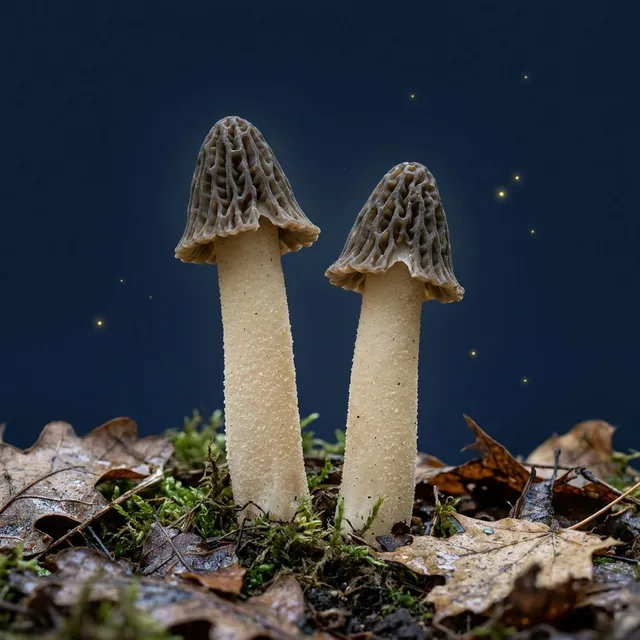
Half-free morel
Morchella semilibera
Protected species
Polish folk names: mitrówka półwolna, smardz półwolny
How to recognise
- Cap small, 2–4 cm, conical, with dark longitudinal ridges and paler pits.
- Cap attached to the stem for about half its length, the lower edge free.
- Stem tall, white or cream, granular, brittle and hollow inside.
- Appears in spring, in April and May.
Where and when it grows
Moist deciduous forests, riparian forests, parks and gardens, often under ash, alder and elm. April and May.
JanFebMarAprMayJunJulAugSepOctNovDec
Most often under: floodplain forests, parks, gardens, under ash, alder and elm.
Beware of the lookalike
False morel. A false morel has a cap folded like a brain and no free margin. The half-free morel has longitudinal ribs and a hollow stem.
Good to know
Edible only after thorough cooking, but protected in Poland, so it must not be picked in the forest. Do not confuse it with the poisonous false morel.
Frequently asked questions
Is half-free morel edible?
No, half-free morel is inedible. Edible only after thorough cooking, but protected in Poland, so it must not be picked in the forest. Do not confuse it with the poisonous false morel.
When does half-free morel grow?
April – May. Moist deciduous forests, riparian forests, parks and gardens, often under ash, alder and elm. April and May.
Half-free morel: what is it easily confused with?
Most often with the species False morel. A false morel has a cap folded like a brain and no free margin. The half-free morel has longitudinal ribs and a hollow stem.