

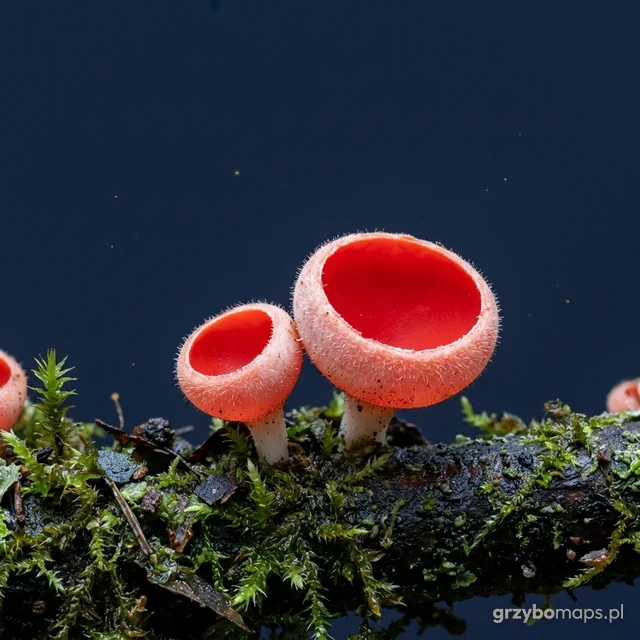
Scarlet elf cup
Sarcoscypha coccinea
Polish folk names: czarka austriacka (gatunek bliźniaczy), kielonka
How to recognise
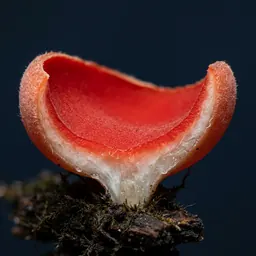
- Fruiting body cup- or goblet-shaped, 1–5 cm in diameter.
- Inside bright scarlet, smooth; outside paler, pinkish-whitish, with tiny hairs.
- Short stalk attached to a twig buried in moss or leaf litter.
- Appears in the cold season, often while snow is still on the ground.
Up close
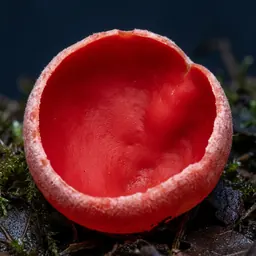 scarlet
Inside
Inside of the cup bright scarlet, smooth.
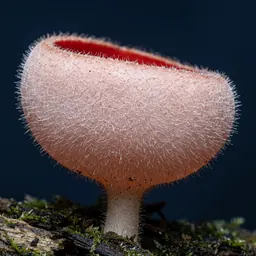 hairs
Outer side
Outer side paler, pinkish-whitish, with fine hairs.
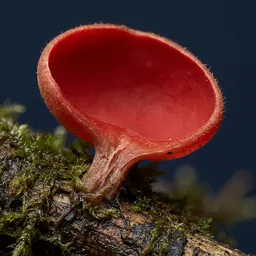 on a twig
Attachment
Short stalk attached to a buried twig.
 cienki
Cross-section
Flesh thin, whitish, brittle.
The close-ups are AI illustrations. Any doubt is settled by a mycologist or herbalist, not by a photo.
Where and when it grows
Damp deciduous forests, floodplain forests and thickets by streams, on fallen twigs (beech, elm, alder, willow). From November to May, most in February–April.
JanFebMarAprMayJunJulAugSepOctNovDec
Most often under: beech, elm, alder, willow, hazel (fallen twigs).
Beware of the lookalike
Orange peel fungus. The orange peel fungus (Aleuria aurantia) is orange, grows in autumn on bare ground by roads, not on twigs.
Feature-by-feature comparison: Orange peel fungus or Scarlet elf cup?
Good to know
No culinary value (small, not very fleshy); described as edible in some sources. A rare species on the Red List – better not to pick it. Telling it apart from Sarcoscypha austriaca requires a microscope.
Where in Poland
Most records in the GBIF database: lubelskie, podlaskie, zachodniopomorskie, podkarpackie, pomorskie.
Frequently asked questions
Is scarlet elf cup edible?
No, scarlet elf cup is inedible. No culinary value (small, not very fleshy); described as edible in some sources. A rare species on the Red List – better not to pick it. Telling it apart from Sarcoscypha austriaca requires a microscope.
When does scarlet elf cup grow?
January, February, March, April, May, November, December. Damp deciduous forests, floodplain forests and thickets by streams, on fallen twigs (beech, elm, alder, willow). From November to May, most in February–April.
Scarlet elf cup: what is it easily confused with?
Most often with the species Orange peel fungus. The orange peel fungus (Aleuria aurantia) is orange, grows in autumn on bare ground by roads, not on twigs.
Where in Poland does scarlet elf cup grow?
Most records (GBIF): lubelskie, podlaskie, zachodniopomorskie, podkarpackie, pomorskie. Most often under: beech, elm, alder, willow, hazel (fallen twigs).