

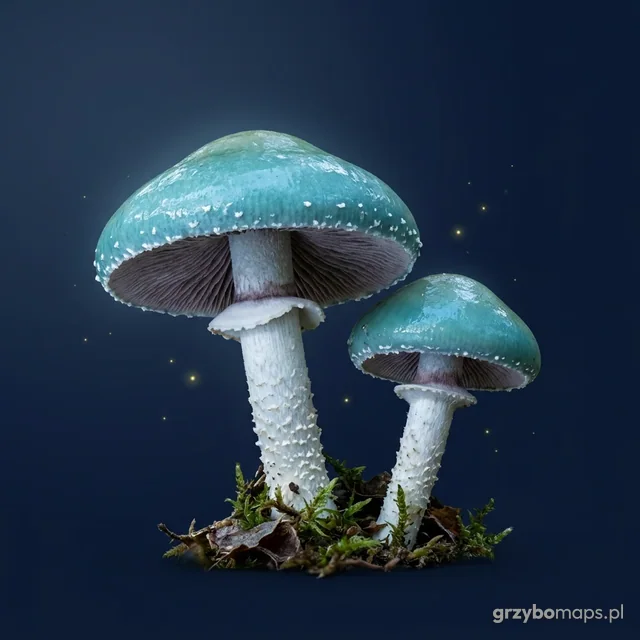
Verdigris agaric
Stropharia aeruginosa
Polish folk names: pierścieniak niebieskozielony, łysiczka niebieskozielona
How to recognise
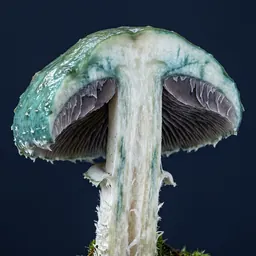
- Cap 3–8 cm, intensely blue-green, slimy, with white patches at the edge; turns yellow with age.
- Gills grey to violet-brown, with a white edge.
- Stem with a distinct, membranous ring, white scales below.
- Spore print violet-brown.
Up close
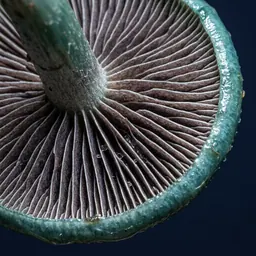 szare blaszki
Underside of the cap
Gills grey to violet-brown, with a white edge.
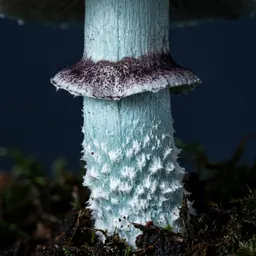 ring
Stem
Stem with a membranous ring, white scales below it.
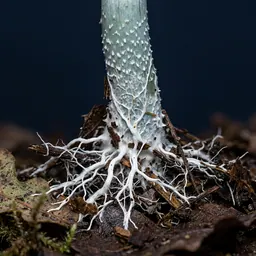 white cords
Base of the stem
Base with white cords of mycelium.
 niebieskawy
Cross-section
Flesh whitish with a bluish tinge.
The close-ups are AI illustrations. Any doubt is settled by a mycologist or herbalist, not by a photo.
Where and when it grows
In various forests, at their edges and in parks, on humus-rich soil and wood debris, in damp places; from August to November.
JanFebMarAprMayJunJulAugSepOctNovDec
Most often under: various – broadleaved and coniferous forests, parks.
Beware of the lookalike
Blue roundhead. The blue roundhead (S. caerulea) is very similar, but has gills without a white edge and a non-persistent ring. Neither is fit to eat.
Good to know
Sources differ: Wikipedia and grzyby.pl state that it is edible after removing the slimy skin (weak taste, the skin irritates the digestive tract), the NaGrzyby atlas says inedible. Marked as inedible as a precaution.
Where in Poland
Most records in the GBIF database: wielkopolskie, małopolskie, mazowieckie, śląskie, zachodniopomorskie.
Frequently asked questions
Is verdigris agaric edible?
No, verdigris agaric is inedible. Sources differ: Wikipedia and grzyby.pl state that it is edible after removing the slimy skin (weak taste, the skin irritates the digestive tract), the NaGrzyby atlas says inedible. Marked as inedible as a precaution.
When does verdigris agaric grow?
August – November. In various forests, at their edges and in parks, on humus-rich soil and wood debris, in damp places; from August to November.
Verdigris agaric: what is it easily confused with?
Most often with the species Blue roundhead. The blue roundhead (S. caerulea) is very similar, but has gills without a white edge and a non-persistent ring. Neither is fit to eat.
Where in Poland does verdigris agaric grow?
Most records (GBIF): wielkopolskie, małopolskie, mazowieckie, śląskie, zachodniopomorskie. Most often under: various – broadleaved and coniferous forests, parks.