

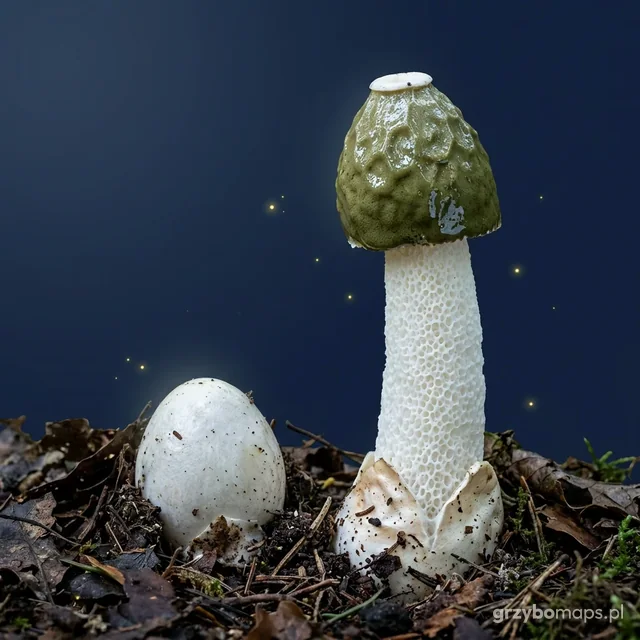
Common stinkhorn
Phallus impudicus
Polish folk names: sromotnik bezwstydny, sromotnik wstydliwy, czarcie jajo, panna-bedłka
How to recognise
- When young it is a white "egg" the size of a hen's egg, partly in the ground, with jelly inside.
- Mature: a white, spongy, hollow column 10–25 cm tall rising from the egg's volva.
- At the top a bell-shaped head covered with olive-green, stinking slime.
- An intense smell of carrion attracts flies, which eat the slime.
Up close
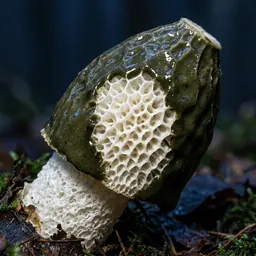 green slime
Flower head
Head bell-shaped, covered with olive-green, foul-smelling slime; net-like beneath the slime.
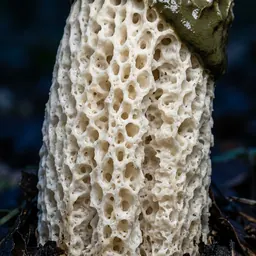 spongy
Stem
White, spongy, hollow stalk, 10–25 cm.
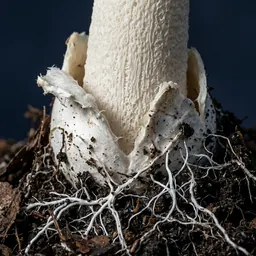 volva / egg
Base
At the base a volva left from the white “egg”. A young egg is easily mistaken for a puffball.
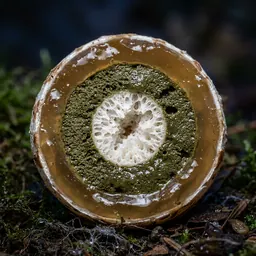 jelly in the egg
Cross-section of the egg
Cut egg: a layer of jelly, a greenish head and a white embryo of the stalk – not the uniform white of a puffball.
The close-ups are AI illustrations. Any doubt is settled by a mycologist or herbalist, not by a photo.
Where and when it grows
Deciduous and coniferous forests, parks, gardens, on fertile soil and by rotting wood. From June to October; common.
JanFebMarAprMayJunJulAugSepOctNovDec
Most often under: broadleaved and coniferous forests, parks, gardens.
Beware of the lookalike
Death cap. A young stinkhorn (“devil's egg”) resembles an amanita egg. A cut stinkhorn egg has jelly and a greenish outline of the cap; an amanita has the outline of a cap with gills.
Feature-by-feature comparison: Dog stinkhorn or Common stinkhorn?
Good to know
Not poisonous. The mature fruiting body is inedible (stench); young "eggs" are described as edible in some sources, but they are easily confused with amanita eggs – we do not recommend it.
Where in Poland
Most records in the GBIF database: podlaskie, wielkopolskie, pomorskie, małopolskie, dolnośląskie.
Frequently asked questions
Is common stinkhorn edible?
No, common stinkhorn is inedible. Not poisonous. The mature fruiting body is inedible (stench); young "eggs" are described as edible in some sources, but they are easily confused with amanita eggs – we do not recommend it.
When does common stinkhorn grow?
June – October. Deciduous and coniferous forests, parks, gardens, on fertile soil and by rotting wood. From June to October; common.
Common stinkhorn: what is it easily confused with?
Most often with the species Death cap. A young stinkhorn (“devil's egg”) resembles an amanita egg. A cut stinkhorn egg has jelly and a greenish outline of the cap; an amanita has the outline of a cap with gills.
Where in Poland does common stinkhorn grow?
Most records (GBIF): podlaskie, wielkopolskie, pomorskie, małopolskie, dolnośląskie. Most often under: broadleaved and coniferous forests, parks, gardens.