

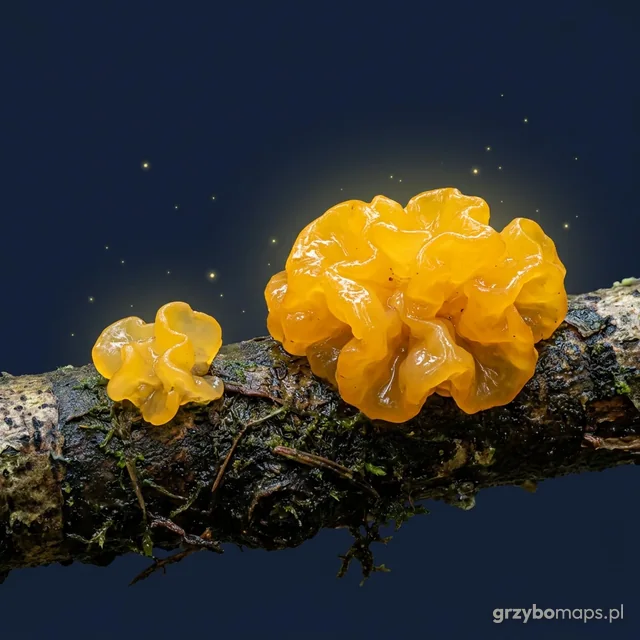
Yellow brain fungus
Tremella mesenterica
Polish folk names: trzęsak krezkowy, żółty mózg
How to recognise
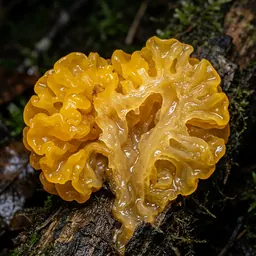
- Fruiting body gelatinous, folded like a brain or intestines, 2–9 cm.
- Colour bright yellow to orange, translucent when damp.
- In drought it shrinks into a hard, orange crust, after rain it swells again.
- Parasitises the mycelium of Peniophora crust fungi (powłocznice) on dead branches of deciduous trees.
Up close
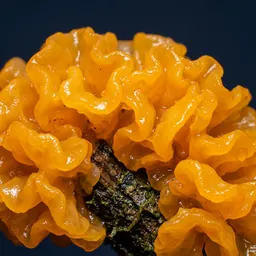 like a brain
Surface
Fruiting body gelatinous, folded like a brain, bright yellow.
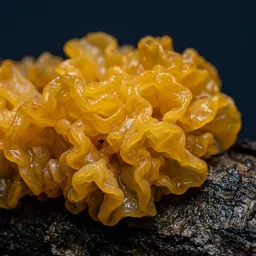 bez trzonu
Shape
No stem and cap; it shrivels in dry weather.
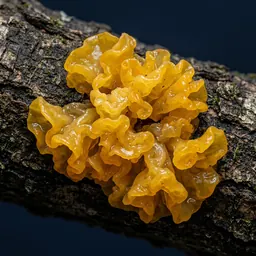 on a branch
Attachment
Grows on dead branches of deciduous trees.
 galareta
Cross-section
Inside translucent jelly.
The close-ups are AI illustrations. Any doubt is settled by a mycologist or herbalist, not by a photo.
Where and when it grows
On fallen and dead hanging branches of deciduous trees (beech, oak, ash, hazel). All year round, most often from late autumn to spring.
JanFebMarAprMayJunJulAugSepOctNovDec
Most often under: beech, oak, ash, hazel (fallen branches).
Beware of the lookalike
Common jellyspot. Jellyspots (Dacrymyces) form tiny orange droplets of jelly up to 5 mm, not large folded lobes. Neither has any culinary value.
Good to know
Harmless but considered inedible (tasteless and of no value).
Where in Poland
Most records in the GBIF database: małopolskie, mazowieckie, wielkopolskie, śląskie, dolnośląskie.
Frequently asked questions
Is yellow brain fungus edible?
No, yellow brain fungus is inedible. Harmless but considered inedible (tasteless and of no value).
When does yellow brain fungus grow?
January, February, March, April, October, November, December. On fallen and dead hanging branches of deciduous trees (beech, oak, ash, hazel). All year round, most often from late autumn to spring.
Yellow brain fungus: what is it easily confused with?
Most often with the species Common jellyspot. Jellyspots (Dacrymyces) form tiny orange droplets of jelly up to 5 mm, not large folded lobes. Neither has any culinary value.
Where in Poland does yellow brain fungus grow?
Most records (GBIF): małopolskie, mazowieckie, wielkopolskie, śląskie, dolnośląskie. Most often under: beech, oak, ash, hazel (fallen branches).