

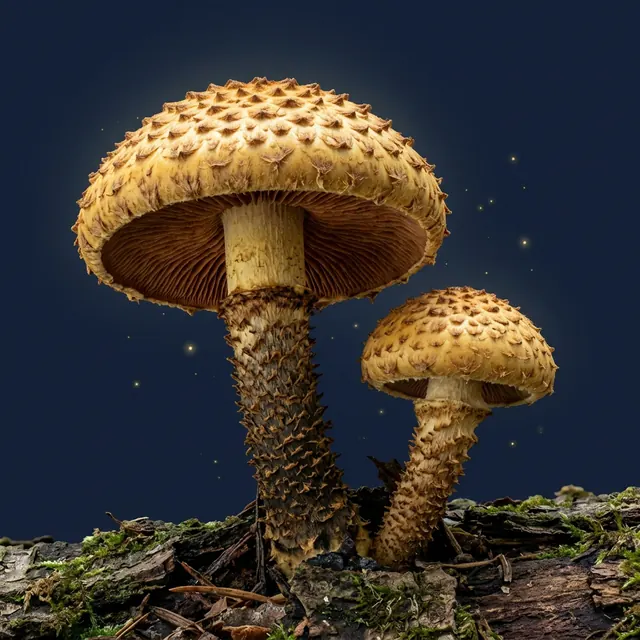
Shaggy scalycap
Pholiota squarrosa
Polish folk names: łuszczak nastroszony
How to recognise
- Cap 2–15 cm, ochre to brown, densely covered with spreading scales, margin inrolled for a long time.
- Gills crowded, adnate, yellowish when young, then rusty-brown.
- Stem 4–8 cm, up to 12 mm thick, with a ring, scaly below it.
- Flesh yellowish, taste slightly radish-like; spore print brown.
Up close
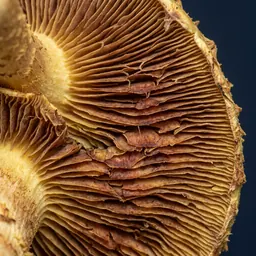 rdzawe blaszki
Underside of the cap
Gills crowded, adnate, yellowish when young, then rusty-brown.
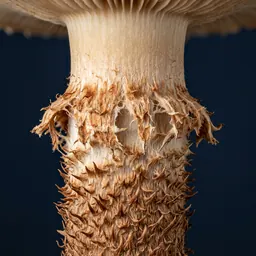 scales and ring
Stem
Stem with a ring; smooth above it, below it covered with spreading scales like the cap.
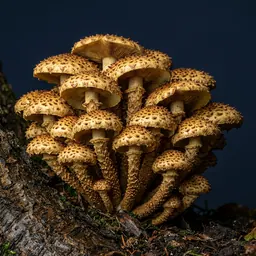 clump by the trunk
Base of the stem
Stems fused into a large clump at the base of the trunk, darker at the bottom.
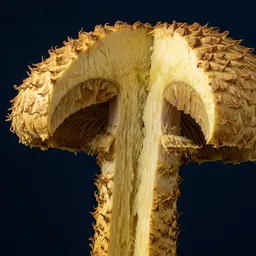 yellowish flesh
Cross-section
Flesh yellowish, does not change colour, taste mildly radish-like.
The close-ups are AI illustrations. Any doubt is settled by a mycologist or herbalist, not by a photo.
Where and when it grows
Dead wood and bases of living trees, mainly deciduous, in clumps. From June to November.
JanFebMarAprMayJunJulAugSepOctNovDec
Most often under: beech, ash, birch, poplar and other deciduous trees.
Beware of the lookalike
Honey fungus. The honey fungus has only tiny, easily rubbed-off scales and a white spore print. The shaggy scalycap has thick, spreading scales and a brown spore print.
Feature-by-feature comparison: Honey fungus or Shaggy scalycap?
Good to know
Polish sources regard it as inedible. Poisonings have been described (vomiting, diarrhea after about 10 hours) in people who ate it together with alcohol.
Frequently asked questions
Is shaggy scalycap edible?
No, shaggy scalycap is inedible. Polish sources regard it as inedible. Poisonings have been described (vomiting, diarrhea after about 10 hours) in people who ate it together with alcohol.
When does shaggy scalycap grow?
June – November. Dead wood and bases of living trees, mainly deciduous, in clumps. From June to November.
Shaggy scalycap: what is it easily confused with?
Most often with the species Honey fungus. The honey fungus has only tiny, easily rubbed-off scales and a white spore print. The shaggy scalycap has thick, spreading scales and a brown spore print.