

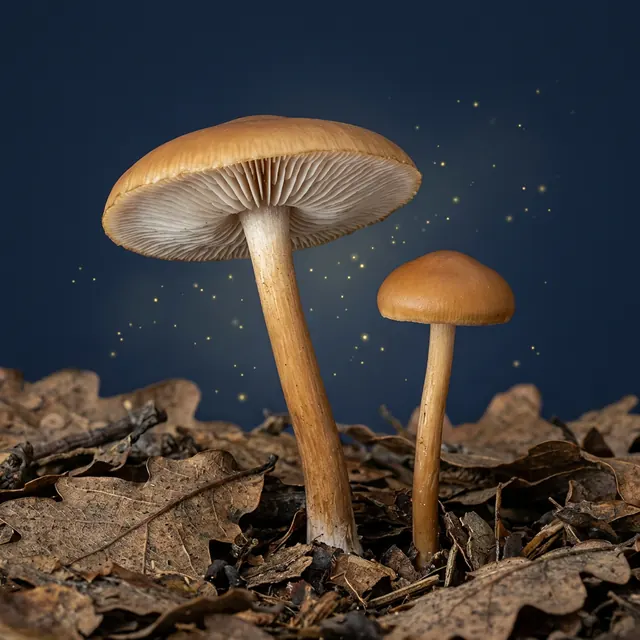
Russet toughshank
Gymnopus dryophilus
Polish folk names: pieniążek dębowy, pieniążek pospolity
How to recognise
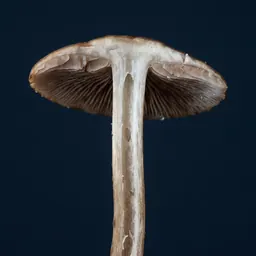
- Cap 1.5–6 cm, smooth, ochre to reddish-brown, hygrophanous, flat.
- Gills very crowded, thin, white, then ochre-cream.
- Stem 3–6 cm, 2–4 mm thick, hollow, smooth, the colour of the cap.
- Threads and white to yellowish mycelial cords at the base.
Up close
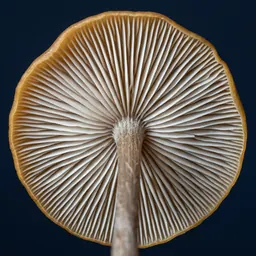 very crowded gills
Underside of the cap
Gills very crowded, thin, brittle, white to cream.
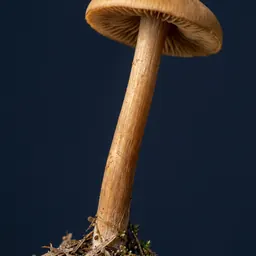 thin, hollow
Stem
Stem thin, tubular, smooth, ochre-brown like the cap.
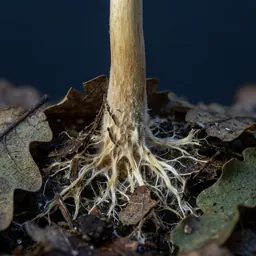 sznury grzybni
Base of the stem
At the base, white to yellowish threads and cords of mycelium that pull out with the soil.
 watery flesh
Cross-section
Flesh thin, whitish, watery, without a distinct smell.
The close-ups are AI illustrations. Any doubt is settled by a mycologist or herbalist, not by a photo.
Where and when it grows
Coniferous and deciduous forests, forest meadows, parks, orchards, on litter. From May to December.
JanFebMarAprMayJunJulAugSepOctNovDec
Most often under: oak, pine and other trees; leaf litter.
Beware of the lookalike
Fairy ring champignon. The fairy ring champignon grows in meadows, has widely spaced gills and a flexible stem. The russet toughshank grows in the forest and has very crowded gills.
Good to know
Polish sources list it as an edible filler mushroom, but English ones describe severe gastrointestinal complaints in some people. It accumulates mercury. We do not recommend eating it.
Frequently asked questions
Is russet toughshank edible?
No, russet toughshank is inedible. Polish sources list it as an edible filler mushroom, but English ones describe severe gastrointestinal complaints in some people. It accumulates mercury. We do not recommend eating it.
When does russet toughshank grow?
May – December. Coniferous and deciduous forests, forest meadows, parks, orchards, on litter. From May to December.
Russet toughshank: what is it easily confused with?
Most often with the species Fairy ring champignon. The fairy ring champignon grows in meadows, has widely spaced gills and a flexible stem. The russet toughshank grows in the forest and has very crowded gills.