

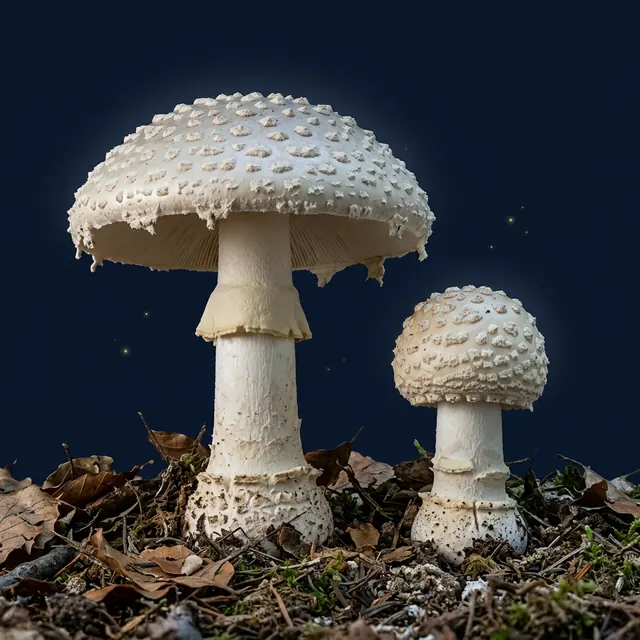
Warted amanita
Amanita strobiliformis
Polish folk names: muchomor samotny, bedłka samotna
How to recognise
- Cap up to 20 cm, cream-white to light grey, covered with soft, lobed patches hanging from the margin.
- Gills white-cream, crowded, bulging.
- Stem up to 15 cm, up to 5 cm thick, with a thick cream ring and a bulb deep in the ground.
- Flesh white, thick, smell faint, of old ham; spore print white.
Up close
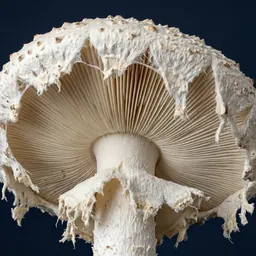 white gills
Underside of the cap
Gills white-cream, crowded, free; shreds of the veil hang from the cap margin.
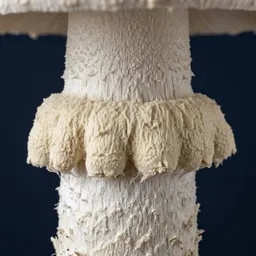 thick ring
Stem
Stem thick, white, solid, with a thick, cream-coloured ring.
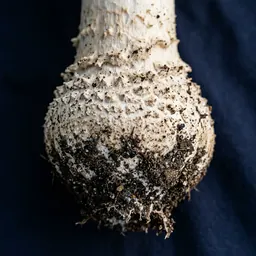 bulb in the soil
Base of the stem
Base swollen into a bulb, deeply embedded in the soil. Dig it out carefully.
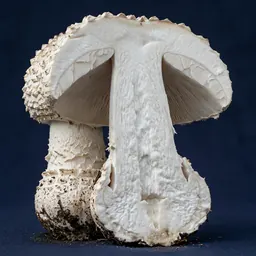 thick white
Cross-section
Flesh white, thick, does not change colour, smell of old ham.
The close-ups are AI illustrations. Any doubt is settled by a mycologist or herbalist, not by a photo.
Where and when it grows
Deciduous and mixed forests, also parks and open areas under single trees, on alkaline soils. In summer. Rare in Poland.
JanFebMarAprMayJunJulAugSepOctNovDec
Most often under: linden, maple, beech, dwarf mountain pine; also parks and roadsides.
Beware of the lookalike
Destroying angel. The destroying angel is pure white, with a smooth cap and a bulb in a sac-like volva. The warted amanita has a cap covered with flaky patches. Avoid both.
Good to know
On the Red List of Fungi of Poland with status R (rare, potentially threatened).
Frequently asked questions
Is warted amanita edible?
Nie. This mushroom is poisonous. No well-documented poisonings. In France it is considered edible, in Germany and in the Polish list of fungi poisonous. It is easily confused with deadly poisonous amanitas.
When does warted amanita grow?
June – August. Deciduous and mixed forests, also parks and open areas under single trees, on alkaline soils. In summer. Rare in Poland.
Warted amanita: what is it easily confused with?
Most often with the species Destroying angel. The destroying angel is pure white, with a smooth cap and a bulb in a sac-like volva. The warted amanita has a cap covered with flaky patches. Avoid both.