

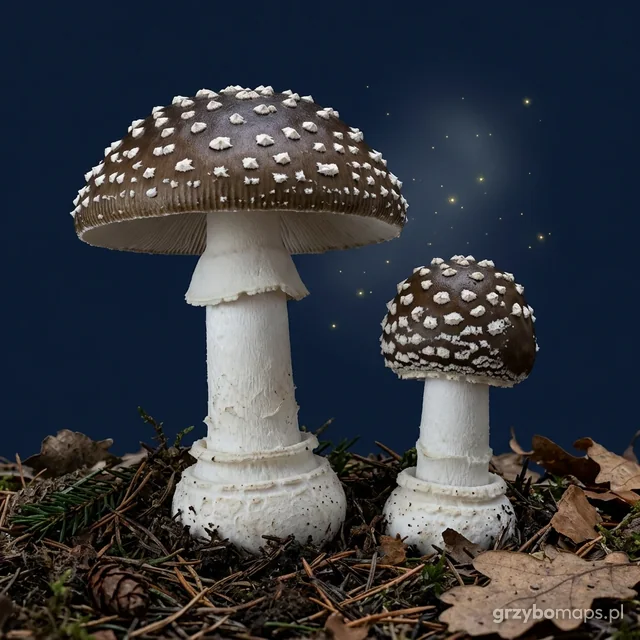
Panther cap
Amanita pantherina
Polish folk names: muchomor panterowy, muchomor pstrokaty
How to recognise
- Brown cap with white patches
- Cap margin striate
- Ring without striations
- Bulb with a wavy sheath
Up close
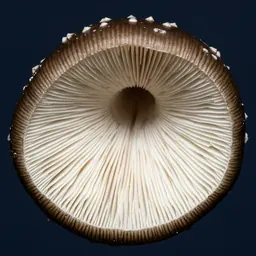 white gills
Underside of the cap
Gills white, free; cap margin striate.
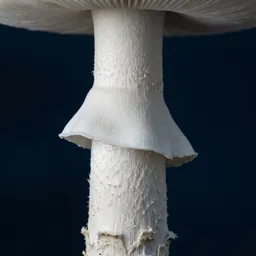 smooth ring
Stem
White stem with a ring without striations (striate in the blusher).
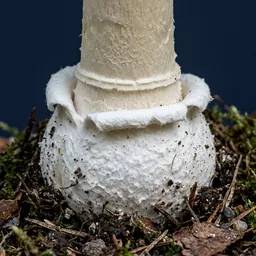 volva with a rim
Base of the stem
A bulb with a close-fitting volva with a distinct, turned-back rim like a sock; above it 1–2 rings.
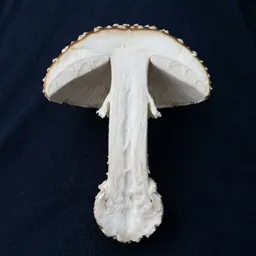 does not redden
Cross-section
Flesh white, does not redden (unlike the blusher).
The close-ups are AI illustrations. Any doubt is settled by a mycologist or herbalist, not by a photo.
Where and when it grows
Mainly deciduous forests, less often coniferous. From June to October. Common in Poland.
JanFebMarAprMayJunJulAugSepOctNovDec
Most often under: broadleaved forests, less often coniferous.
Beware of the lookalike
Blusher. The blusher differs, among other things, by the sheath at the base. Telling them apart is hard, so do not collect either.
Feature-by-feature comparison: Blusher or Panther cap?
Feature-by-feature comparison: Grey spotted amanita or Panther cap?
Where in Poland
Most records in the GBIF database: łódzkie, wielkopolskie, mazowieckie, zachodniopomorskie, pomorskie.
Frequently asked questions
Is panther cap edible?
Nie. This mushroom is poisonous. The same toxins as in the fly agaric, but stronger. Symptoms after 0.5–4 hours: disorientation, dizziness, agitation or drowsiness.
When does panther cap grow?
June – October. Mainly deciduous forests, less often coniferous. From June to October. Common in Poland.
Panther cap: what is it easily confused with?
Most often with the species Blusher. The blusher differs, among other things, by the sheath at the base. Telling them apart is hard, so do not collect either.
Where in Poland does panther cap grow?
Most records (GBIF): łódzkie, wielkopolskie, mazowieckie, zachodniopomorskie, pomorskie. Most often under: broadleaved forests, less often coniferous.