

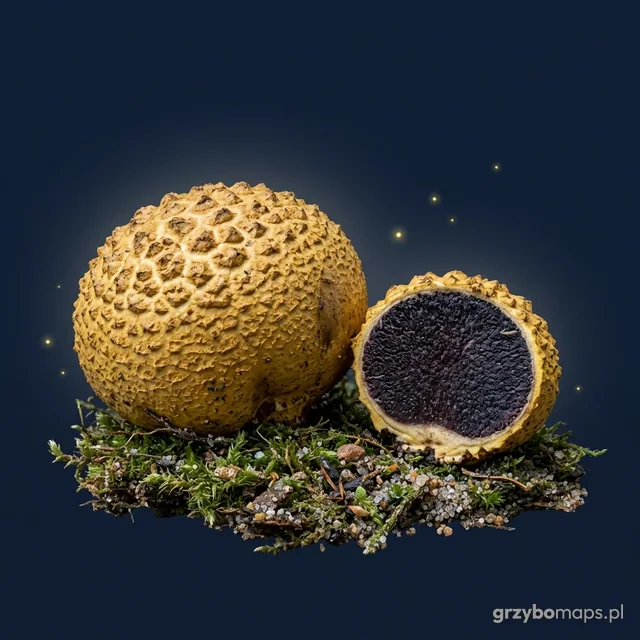
Common earthball
Scleroderma citrinum
Polish folk names: tęgoskór pospolity, fałszywa trufla
How to recognise
- Skin thick, hard, scaly
- Interior white only in young ones, quickly turning yellow-green, then black
Up close
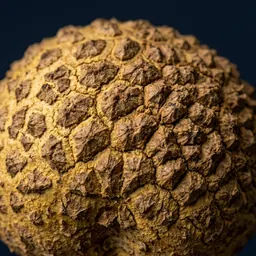 thick scales
Surface
Skin thick, hard, yellowish-brown, cracked into scale-like patches.
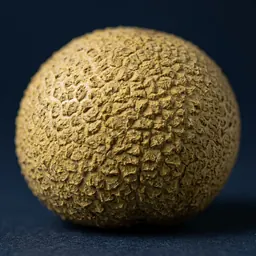 bez trzonu
Shape
Spherical fruiting body without a stem and cap, hard to the touch.
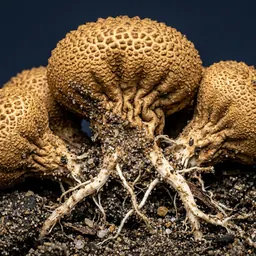 sznury grzybni
Base
Wrinkled base underneath and mycelial cords growing into the soil.
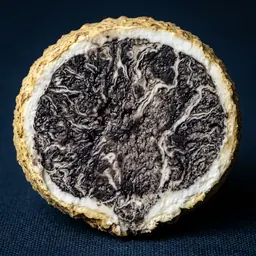 dark interior
Inside
Interior quickly turns violet-black with white veins; the thick white skin is visible in cross-section.
The close-ups are AI illustrations. Any doubt is settled by a mycologist or herbalist, not by a photo.
Where and when it grows
Sands and acidic soils, forest edges, parks, peat bogs. From June to November.
JanFebMarAprMayJunJulAugSepOctNovDec
Most often under: sandy, acidic soils, forest edges.
Beware of the lookalike
Puffball. The puffball has a thin skin with spines and a white interior. The earthball is hard, scaly and dark inside.
Feature-by-feature comparison: Common puffball or Common earthball?
Feature-by-feature comparison: Summer truffle or Common earthball?
Where in Poland
Most records in the GBIF database: mazowieckie, pomorskie, śląskie, zachodniopomorskie, wielkopolskie.
Frequently asked questions
Is common earthball edible?
Nie. This mushroom is poisonous. In larger amounts it causes poisoning.
When does common earthball grow?
June – November. Sands and acidic soils, forest edges, parks, peat bogs. From June to November.
Common earthball: what is it easily confused with?
Most often with the species Puffball. The puffball has a thin skin with spines and a white interior. The earthball is hard, scaly and dark inside.
Where in Poland does common earthball grow?
Most records (GBIF): mazowieckie, pomorskie, śląskie, zachodniopomorskie, wielkopolskie. Most often under: sandy, acidic soils, forest edges.