

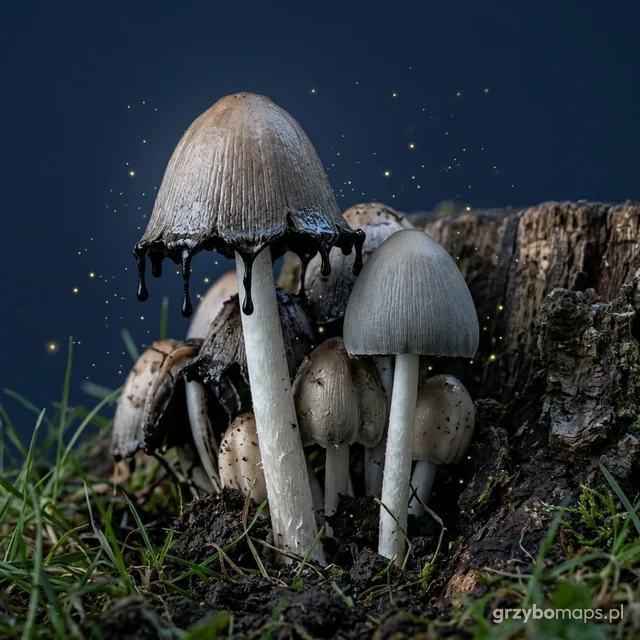
Common ink cap
Coprinopsis atramentaria
Polish folk names: czernidłówka pospolita
How to recognise
- Cap grey or grey-brown, egg-shaped
- Grows in clusters at the base of felled trunks
- With age it dissolves into black
Up close
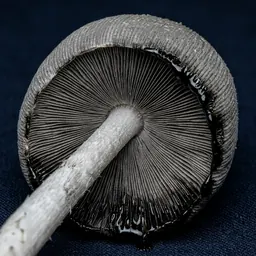 gills turn black
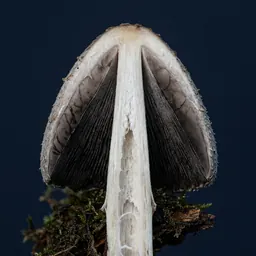
Underside of the cap
Gills dense, white, then grey and black, dissolving into ink.
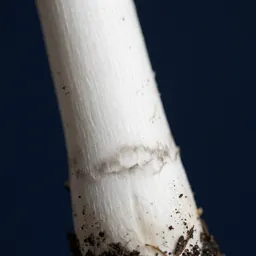 pusty
Stem
Stem white, hollow, smooth; only a ring zone low down.
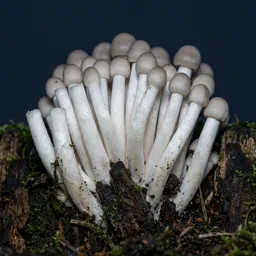 clusters by tree stumps
Base of the stem
Grows in clumps near stumps and buried wood.
 thin flesh
Cross-section
Flesh thin, whitish; stem hollow. Can be poisonous with alcohol.
The close-ups are AI illustrations. Any doubt is settled by a mycologist or herbalist, not by a photo.
Where and when it grows
Near stumps and on the ground, from spring to autumn.
JanFebMarAprMayJunJulAugSepOctNovDec
Most often under: at the base of stumps, on the ground.
Beware of the lookalike
Shaggy ink cap. The shaggy ink cap is white and scaly, and grows singly in grass.
Feature-by-feature comparison: Shaggy ink cap or Common ink cap?
Where in Poland
Most records in the GBIF database: wielkopolskie, łódzkie, małopolskie, mazowieckie, pomorskie.
Frequently asked questions
Is common ink cap edible?
Nie. This mushroom is poisonous. Coprine blocks the breakdown of alcohol. Alcohol drunk even up to 3 days after the meal (rarely even later) usually causes skin flushing, palpitations, sweating, nausea and headache within 5–10 minutes; the symptoms usually pass in 2–3 hours.
When does common ink cap grow?
April – October. Near stumps and on the ground, from spring to autumn.
Common ink cap: what is it easily confused with?
Most often with the species Shaggy ink cap. The shaggy ink cap is white and scaly, and grows singly in grass.
Where in Poland does common ink cap grow?
Most records (GBIF): wielkopolskie, łódzkie, małopolskie, mazowieckie, pomorskie. Most often under: at the base of stumps, on the ground.