

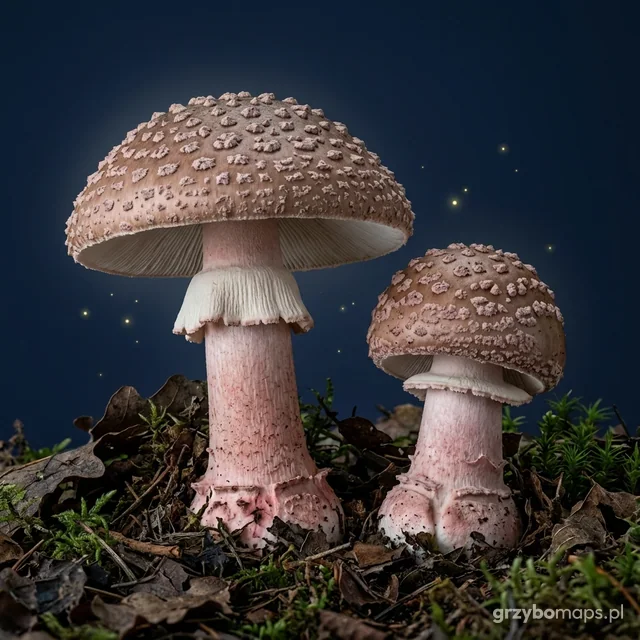
Blusher
Amanita rubescens
How to recognise
- Cap light brown with a pinkish or reddish tinge, covered with dirty-pink warts.
- Flesh white, slowly turning pink when cut and where larvae have fed.
- Ring hanging, distinctly striate on the upper side.
- Stem thickened at the base, pink-brown, without a distinct volva.
Up close
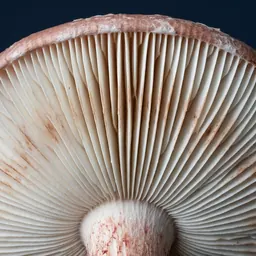 white gills
Underside of the cap
Gills white, free, with reddish spots over time.
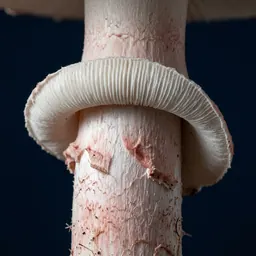 striate ring
Stem
Ring hanging, distinctly striate on the upper side.
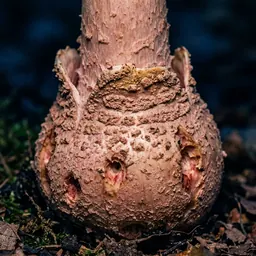 bulwa bez worka
Base of the stem
Bulb swollen, pinkish-brown, without a sack-like volva.
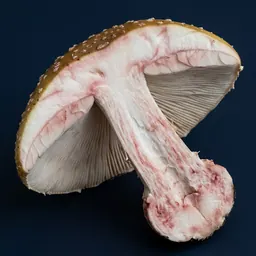 turns pink
Cross-section
Flesh white, slowly turns pink when cut.
The close-ups are AI illustrations. Any doubt is settled by a mycologist or herbalist, not by a photo.
Where and when it grows
Very common in coniferous, deciduous and mixed forests; from June to November.
JanFebMarAprMayJunJulAugSepOctNovDec
Most often under: pine, spruce, beech, oak, birch.
Beware of the lookalike
Panther cap. The panther cap has pure white warts, a striated cap margin, a smooth ring and flesh that does not turn red. The blusher has a ring that is striated on top and flesh that turns pink.
In the kitchen
Only young, healthy specimens, cooked for at least 15–20 minutes (pour off the water); never raw.
Good to know
Edible only after thorough cooking – raw it contains haemolysins that are destroyed at high temperature. Not for beginners: it is easily confused with the poisonous panther cap. Often wormy.
Where in Poland
Most records in the GBIF database: łódzkie, pomorskie, wielkopolskie, małopolskie, dolnośląskie.
Frequently asked questions
Is blusher edible?
Warunkowo. Edible only after thorough cooking – raw it contains haemolysins that are destroyed at high temperature. Not for beginners: it is easily confused with the poisonous panther cap. Often wormy.
When does blusher grow?
June – November. Very common in coniferous, deciduous and mixed forests; from June to November.
Blusher: what is it easily confused with?
Most often with the species Panther cap. The panther cap has pure white warts, a striated cap margin, a smooth ring and flesh that does not turn red. The blusher has a ring that is striated on top and flesh that turns pink.
Where in Poland does blusher grow?
Most records (GBIF): łódzkie, pomorskie, wielkopolskie, małopolskie, dolnośląskie. Most often under: pine, spruce, beech, oak, birch.