

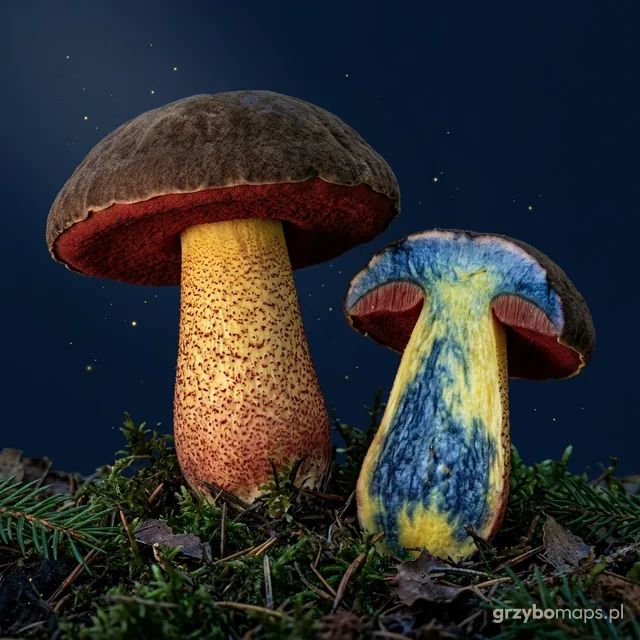
Scarletina bolete
Neoboletus luridiformis
Polish folk names: borowik ceglastopory, ceglak
How to recognise
- Pores red
- Stem with fine carmine scales, without a net
- Flesh turns strongly blue when damaged
Up close
 czerwone pory
Underside of the cap
Pores small, red to orange-red; turning dark blue immediately when touched.
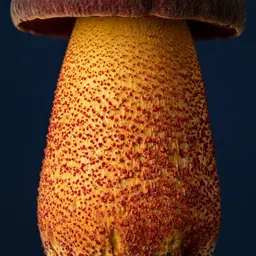 dots, no net
Stem
Stem yellow, densely covered with small red dots; no net.
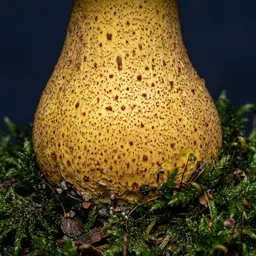 bez pochwy
Base of the stem
Base thickened, without a volva; sometimes with yellowish mycelium.
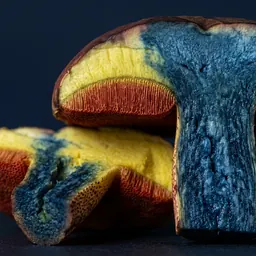 sinieje
Cross-section
Flesh bright yellow, immediately turning strongly dark blue when cut.
The close-ups are AI illustrations. Any doubt is settled by a mycologist or herbalist, not by a photo.
Where and when it grows
Deciduous and coniferous forests, more common in the mountains. From May to late autumn.
JanFebMarAprMayJunJulAugSepOctNovDec
Most often under: beech, spruce, fir.
Beware of the lookalike
Devil's bolete. The devil's bolete has a pale grey cap and grows in warm forests under oaks and beeches, on limestone soil. It is poisonous, very rare and strictly protected.
Feature-by-feature comparison: Scarletina bolete or Devil's bolete?
In the kitchen
Only well cooked, never raw. Good for sauce.
Good to know
Raw, it is poisonous. Eat only when well cooked.
Where in Poland
Most records in the GBIF database: małopolskie, dolnośląskie, pomorskie, zachodniopomorskie, podkarpackie.
Recipes with this mushroom
Frequently asked questions
Is scarletina bolete edible?
Warunkowo. Raw, it is poisonous. Eat only when well cooked.
When does scarletina bolete grow?
May – November. Deciduous and coniferous forests, more common in the mountains. From May to late autumn.
Scarletina bolete: what is it easily confused with?
Most often with the species Devil's bolete. The devil's bolete has a pale grey cap and grows in warm forests under oaks and beeches, on limestone soil. It is poisonous, very rare and strictly protected.
Where in Poland does scarletina bolete grow?
Most records (GBIF): małopolskie, dolnośląskie, pomorskie, zachodniopomorskie, podkarpackie. Most often under: beech, spruce, fir.