

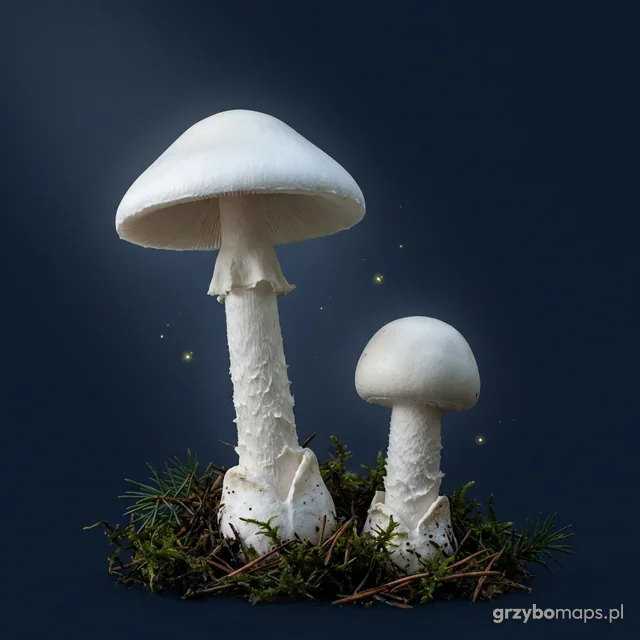
Destroying angel
Amanita virosa
Polish folk names: muchomor biały
How to recognise
- Entirely white, cap silky
- Gills always white, free
- Sheath at the base of the stem
- Smell unpleasant, stifling
Up close
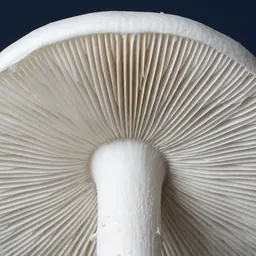 white gills
Underside of the cap
Gills always white, free – in button mushrooms pink and brown with age.
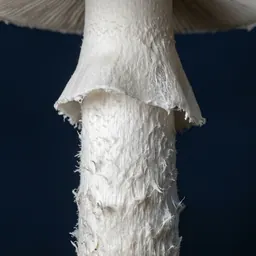 shaggy + ring
Stem
White stem covered with shaggy fibrils, with a fleeting white ring.
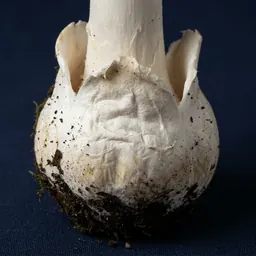 pochwa
Base of the stem
A bulb in a white, sac-like volva, often hidden in the soil. Always twist out the whole mushroom.
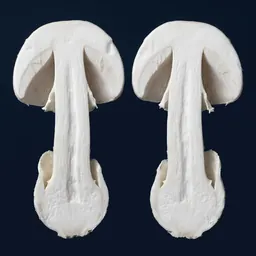 all white
Cross-section
Flesh white, does not change colour; unpleasant, suffocating smell.
The close-ups are AI illustrations. Any doubt is settled by a mycologist or herbalist, not by a photo.
Where and when it grows
Mountain coniferous forests under spruce and pine, beech forests, also under birches. In summer and autumn.
JanFebMarAprMayJunJulAugSepOctNovDec
Most often under: coniferous forests with moss, beech woods, birches.
Beware of the lookalike
Field mushroom. The field mushroom has pink, later brown gills and no sheath. The destroying angel always has white gills and a sheath at the base.
Feature-by-feature comparison: Field mushroom or Destroying angel?
Feature-by-feature comparison: White dapperling or Destroying angel?
Where in Poland
Most records in the GBIF database: pomorskie, łódzkie, małopolskie, lubelskie, zachodniopomorskie.
Frequently asked questions
Is destroying angel edible?
No. It is a deadly poisonous mushroom. Amatoxins as in the death cap: a small amount can kill. Symptoms delayed by many hours.
When does destroying angel grow?
August – October. Mountain coniferous forests under spruce and pine, beech forests, also under birches. In summer and autumn.
Destroying angel: what is it easily confused with?
Most often with the species Field mushroom. The field mushroom has pink, later brown gills and no sheath. The destroying angel always has white gills and a sheath at the base.
Where in Poland does destroying angel grow?
Most records (GBIF): pomorskie, łódzkie, małopolskie, lubelskie, zachodniopomorskie. Most often under: coniferous forests with moss, beech woods, birches.