

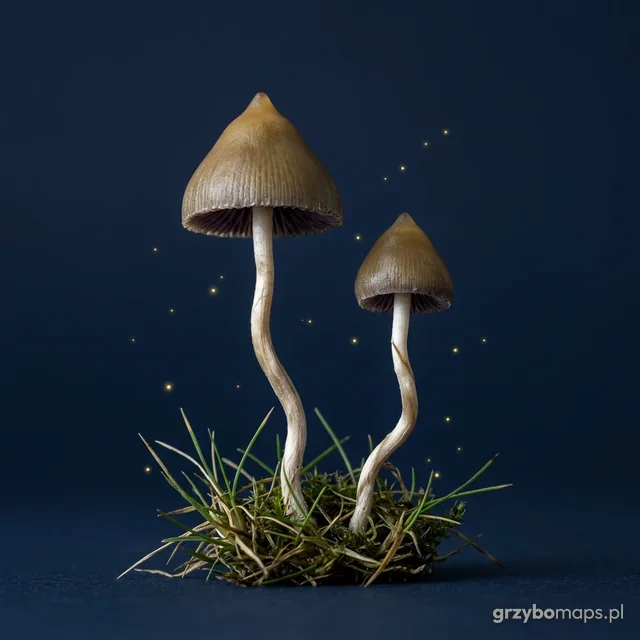
Liberty cap
Psilocybe semilanceata
Polish folk names: kołpaczek lancetowaty, czapka wolności
How to recognise
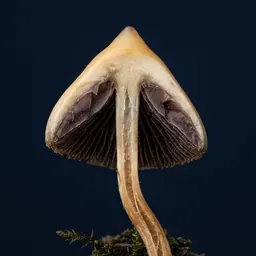
- Cap 0.5–2.5 cm, sharply conical, with a distinct pointed nipple at the top.
- Hygrophanous cap: olive-brown and sticky when wet, pale beige when dry; margin often striate.
- Gills first cream, then violet-brown to almost black; spore print dark violet-brown.
- Stem very thin, long, flexible, pale; at the base sometimes bluish-greenish.
Up close
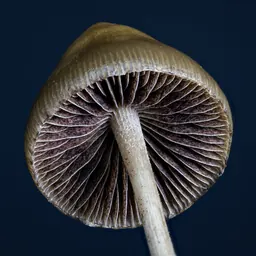 ciemne blaszki
Underside of the cap
Gills narrow, adnate, cream, then violet-brown to almost black, with a paler edge.
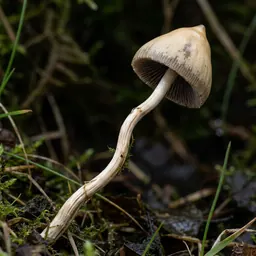 thin, flexible
Stem
Stem very thin, long, flexible, pale, without a ring.
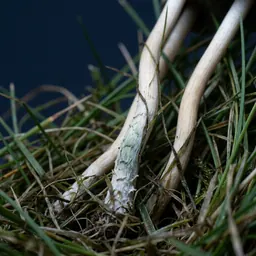 w trawie
Base of the stem
Grows in grass in pastures; the base is sometimes bluish-green.
 thin flesh
Cross-section
Flesh very thin, cap conical with a sharp papilla at the top.
The close-ups are AI illustrations. Any doubt is settled by a mycologist or herbalist, not by a photo.
Where and when it grows
Damp, unfertilised or lightly fertilised meadows and pastures (also grazed by sheep), in the grass, not on the manure itself. Late summer and autumn, usually August–November.
JanFebMarAprMayJunJulAugSepOctNovDec
Most often under: none – meadows and pastures.
Beware of the lookalike
Conocybe rugosa. The stożkówka has rusty-brown (not violet-black) gills and spores and usually a ring on the stem; it contains deadly amanitins. Small brown mushrooms from grass cannot be safely told apart “by eye”.
Law
Psilocybin and psilocin are psychotropic substances in Poland (Act on Counteracting Drug Addiction, group I-P); possession of mushrooms containing them is punishable.
Where in Poland
Most records in the GBIF database: dolnośląskie, pomorskie, śląskie, kujawsko-pomorskie, łódzkie.
Frequently asked questions
Is liberty cap edible?
Nie. This mushroom is poisonous. Psilocybin (converted to psilocin in the body). Symptoms usually after 20–60 min: dilated pupils, nausea, palpitations, perception disturbances and hallucinations, anxiety; they usually subside after about 4–6 h. Symptoms appearing only after 6 h or later suggest a mix-up with a mushroom containing amanitins (Galerina, Conocybe) – then go to hospital immediately.
When does liberty cap grow?
August – November. Damp, unfertilised or lightly fertilised meadows and pastures (also grazed by sheep), in the grass, not on the manure itself. Late summer and autumn, usually August–November.
Liberty cap: what is it easily confused with?
Most often with the species Conocybe rugosa. The stożkówka has rusty-brown (not violet-black) gills and spores and usually a ring on the stem; it contains deadly amanitins. Small brown mushrooms from grass cannot be safely told apart “by eye”.
Where in Poland does liberty cap grow?
Most records (GBIF): dolnośląskie, pomorskie, śląskie, kujawsko-pomorskie, łódzkie. Most often under: none – meadows and pastures.
Sources
- Wikipedia: Łysiczka lancetowata
- Wikipedia: Grzyby psylocybinowe
- Wikipedia (en): Psilocybe semilanceata
- Zatrucia grzybami halucynogennymi – opis przypadków, Kraków (bibliotekanauki.pl)
- Zatrucia psylocyną i jej pochodnymi (Current Problems of Psychiatry, UM Lublin)
- Sejm RP: interpelacja nr 3430 (grzyby psylocybinowe a prawo)
- Wikipedia: Łysiczka lancetowata