

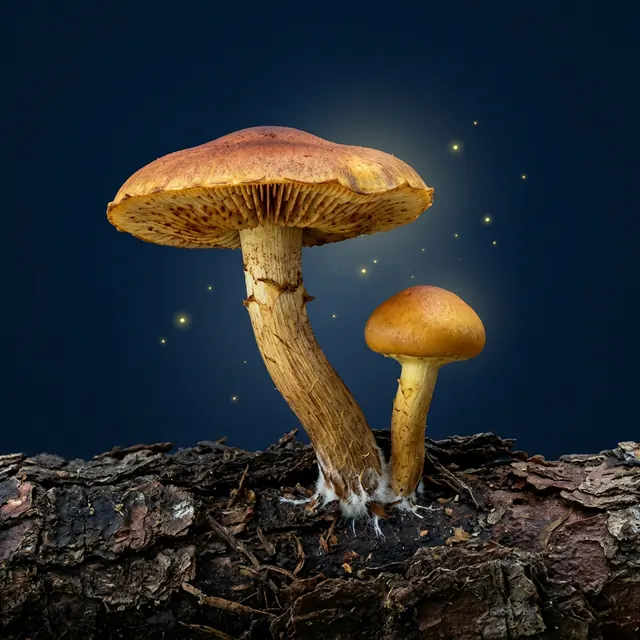
Gymnopilus penetrans
Gymnopilus penetrans
Polish folk names: płomiennica korzeniasta, ogniówka przenikająca
How to recognise
- Cap 2–9 cm, orange-rusty, darker in the centre, golden yellow near the margin, often with a blunt umbo.
- Gills notched, yellow when young, then yellow-rusty, often with rusty spots.
- Stem 3–8 cm, yellow at the top, brownish lower down, with a fading fibrillose zone, white mycelium at the base.
- Taste more or less bitter; spore print rusty brown.
Up close
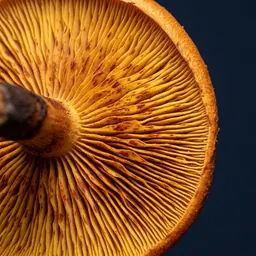 plamiste blaszki
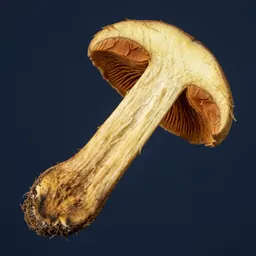
Underside of the cap
Gills yellow, yellow-rusty with age, often with small rusty speckles.
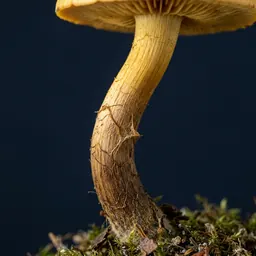 no ring
Stem
Stem yellow under the cap, brownish lower down; in young ones a fading, fibrous ring zone.
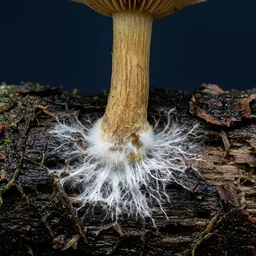 white mycelium
Base of the stem
Base with a white, cottony coating of mycelium, grown into wood or sawdust.
 bitter flesh
Cross-section
Flesh pale yellow to reddish-yellowish, brown at the base. Taste bitter.
The close-ups are AI illustrations. Any doubt is settled by a mycologist or herbalist, not by a photo.
Where and when it grows
On fallen trunks, branches, bark and sawdust of coniferous trees, also at timber yards. From August to November; common.
JanFebMarAprMayJunJulAugSepOctNovDec
Most often under: coniferous wood: stumps, branches, sawdust.
Beware of the lookalike
Sheathed woodtuft. The sheathed woodtuft grows in dense clumps on deciduous wood, has a two-coloured cap and a scaly stem with a ring. The rustgill has only a vanishing zone of fibrils.
Frequently asked questions
Is gymnopilus penetrans edible?
Nie. This mushroom is poisonous. Polish sources give it as inedible or mildly poisonous. Bitter taste; if eaten it can cause stomach complaints. It does not contain psilocybin.
When does gymnopilus penetrans grow?
August – November. On fallen trunks, branches, bark and sawdust of coniferous trees, also at timber yards. From August to November; common.
Gymnopilus penetrans: what is it easily confused with?
Most often with the species Sheathed woodtuft. The sheathed woodtuft grows in dense clumps on deciduous wood, has a two-coloured cap and a scaly stem with a ring. The rustgill has only a vanishing zone of fibrils.