


Sheathed woodtuft
Kuehneromyces mutabilis
Polish folk names: łuszczak zmienny, opieńka zmienna
How to recognise
- Grows in dense clumps on stumps and dead wood of deciduous trees.
- Cap 2–6 cm, honey-brown, hygrophanous: as it dries it lightens from the centre, making it two-coloured.
- Stem with a membranous ring; below the ring densely covered with dark, protruding scales.
- Gills pale, then cinnamon-brown; spore print rusty-brown.
Up close
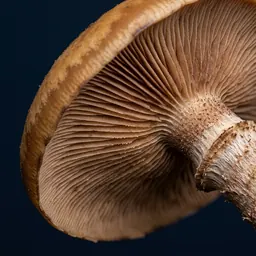 cynamonowe blaszki
Underside of the cap
Gills pale, then cinnamon-brown.
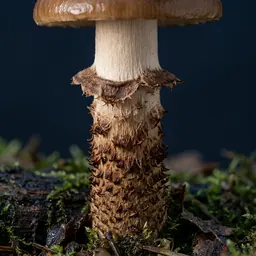 scales below the ring
Stem
Stem with a membranous ring; below it dense, dark, spreading scales (the Galerina has smooth fibrils).
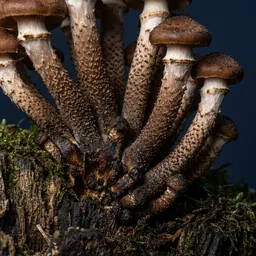 clumps on wood
Base of the stem
Dense clumps on stumps of deciduous trees; stems dark at the bottom. Always twist out the whole mushroom.
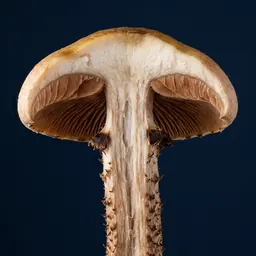 thin flesh
Cross-section
Flesh thin, pale, pleasant smell. Easily mistaken for the poisonous Galerina.
The close-ups are AI illustrations. Any doubt is settled by a mycologist or herbalist, not by a photo.
Where and when it grows
Stumps and dead wood of deciduous trees (beech, birch, alder), rarely coniferous; from spring (April) to autumn (November).
JanFebMarAprMayJunJulAugSepOctNovDec
Most often under: beech, birch, alder (stumps of broadleaved trees).
Beware of the lookalike
Funeral bell. The funeral bell has a stem below the ring covered only with silvery, adhering fibres, grows more often on coniferous wood and is deadly poisonous. The scales feature is not always reliable – if in doubt, do not collect.
Feature-by-feature comparison: Sheathed woodtuft or Funeral bell?
In the kitchen
Cook or stew the caps well; they are suitable for soups and sauces. The stems are fibrous.
Good to know
Edible and tasty, but easily confused with the deadly poisonous funeral bell (Galerina marginata), which grows in the same places. Only for experienced foragers; permitted for sale only from cultivation. Eat only the caps, after cooking.
Where in Poland
Most records in the GBIF database: wielkopolskie, pomorskie, zachodniopomorskie, śląskie, mazowieckie.
Frequently asked questions
Is sheathed woodtuft edible?
Warunkowo. Edible and tasty, but easily confused with the deadly poisonous funeral bell (Galerina marginata), which grows in the same places. Only for experienced foragers; permitted for sale only from cultivation. Eat only the caps, after cooking.
When does sheathed woodtuft grow?
April – November. Stumps and dead wood of deciduous trees (beech, birch, alder), rarely coniferous; from spring (April) to autumn (November).
Sheathed woodtuft: what is it easily confused with?
Most often with the species Funeral bell. The funeral bell has a stem below the ring covered only with silvery, adhering fibres, grows more often on coniferous wood and is deadly poisonous. The scales feature is not always reliable – if in doubt, do not collect.
Where in Poland does sheathed woodtuft grow?
Most records (GBIF): wielkopolskie, pomorskie, zachodniopomorskie, śląskie, mazowieckie. Most often under: beech, birch, alder (stumps of broadleaved trees).