

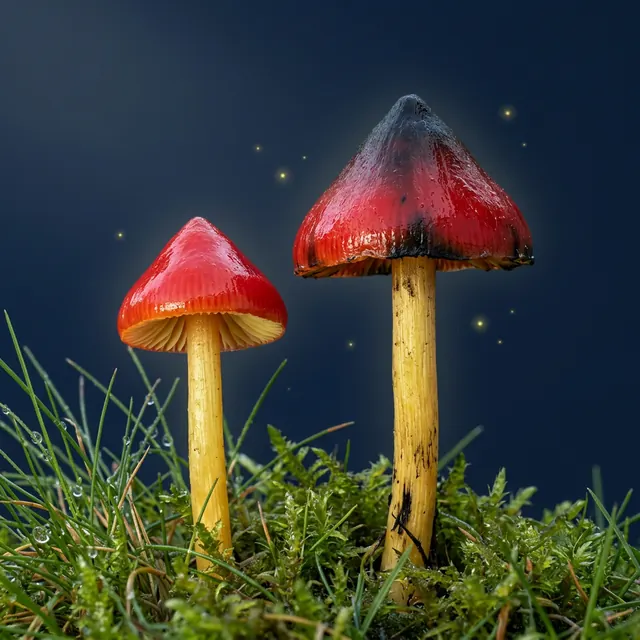
Blackening waxcap
Hygrocybe conica
Polish folk names: wilgotnica stożkowata, bedłka koniczna
How to recognise
- Cap 1–3 (up to 6) cm, sharply conical when young, yellow, orange or scarlet, sticky or silky-shiny.
- Gills almost free, broad, pale yellow to lemon-yellow.
- Stem 6–8 cm, 0.5–1 cm thick, hollow, yellow, fibrous, without a ring.
- When pressed and with age, the whole fruiting body turns black.
Up close
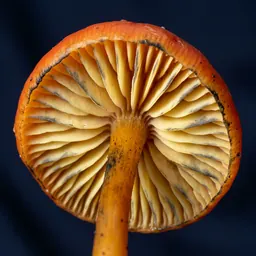 yellow gills
Underside of the cap
Gills almost free, broad, pale yellow to lemon, turning grey and then black with age.
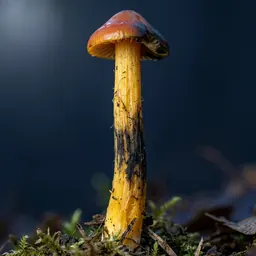 yellow, fibrous
Stem
Stem yellow to orange, hollow, fibrous lengthwise, without a ring.
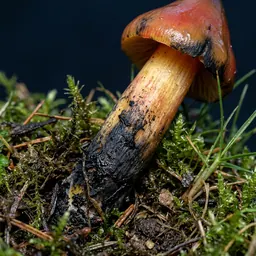 czernieje
Base of the stem
Base and pressed spots quickly turn black.
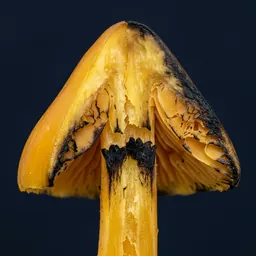 blackening flesh
Cross-section
Flesh brittle, yellow, turns black when cut and with time.
The close-ups are AI illustrations. Any doubt is settled by a mycologist or herbalist, not by a photo.
Where and when it grows
Damp meadows and pastures, also dunes and roadsides. From June to October.
JanFebMarAprMayJunJulAugSepOctNovDec
Most often under: meadows and pastures.
Beware of the lookalike
Other waxcaps. Red waxcaps (scarlet, purple) have a convex, not conical cap, and they do not turn black.
Frequently asked questions
Is blackening waxcap edible?
Nie. This mushroom is poisonous. A mildly poisonous mushroom: according to Polish sources it causes digestive disorders. Data on poisonings are uncertain, the toxin is not known.
When does blackening waxcap grow?
June – October. Damp meadows and pastures, also dunes and roadsides. From June to October.
Blackening waxcap: what is it easily confused with?
Most often with the species Other waxcaps. Red waxcaps (scarlet, purple) have a convex, not conical cap, and they do not turn black.