

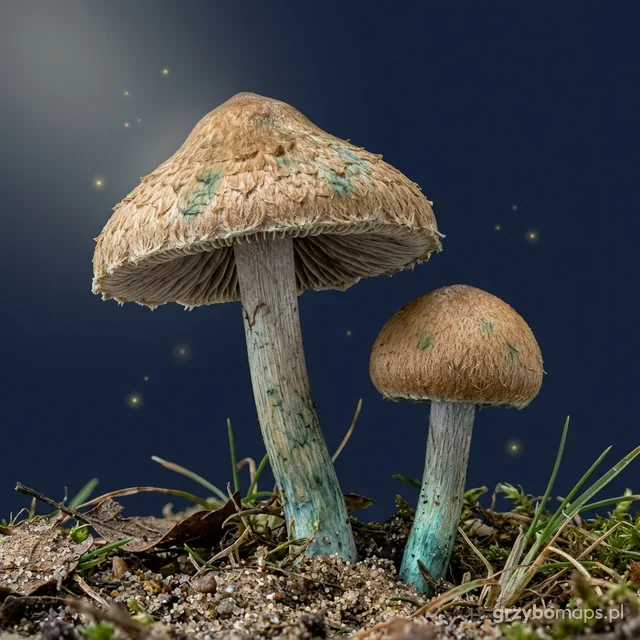
Inocybe aeruginascens
Inocybe aeruginascens
How to recognise
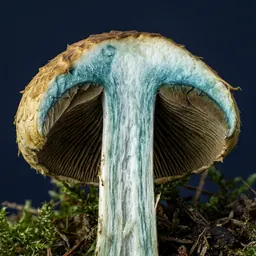
- Cap up to 5 cm, conical to convex, with a umbo, buff to light yellow-brown, fibrous.
- Greenish spots on the cap and flesh; turns blue when damaged.
- Stem solid, light grey, blue-green from the base upwards.
- Smell unpleasant, soapy; young ones have a faint cortina.
Up close
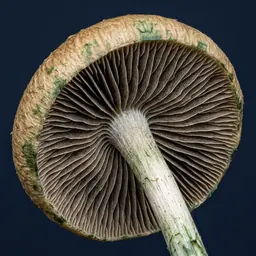 blaszki
Underside of the cap
Gills greyish-brown; cap fibrous with greenish spots.
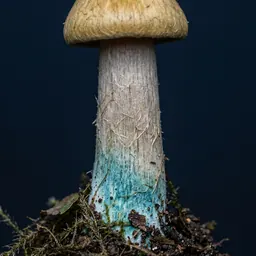 niebieskozielony
Stem
Stem solid, light grey, blue-green from the base upwards.
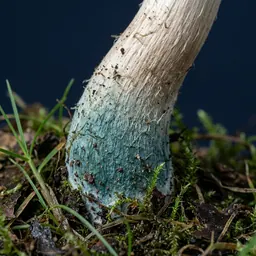 zielona nasada
Base of the stem
Base distinctly blue-green.
 sinieje
Cross-section
Flesh turns blue when damaged; soapy smell.
The close-ups are AI illustrations. Any doubt is settled by a mycologist or herbalist, not by a photo.
Where and when it grows
Parks, avenues and tree groups on sandy ground, near poplars, lindens and oaks. Summer and early autumn. We have not confirmed any sites in Poland in the available sources.
JanFebMarAprMayJunJulAugSepOctNovDec
Most often under: poplar, linden, oak, willow (parks, sandy avenues).
Beware of the lookalike
White fibrecap. Other fibrecaps do not bruise blue, but contain muscarine and are poisonous; in practice fibrecaps cannot be safely told apart in the field.
Law
Psilocybin and psilocin are psychotropic substances in Poland (Act on Counteracting Drug Addiction, group I-P); possession of mushrooms containing them is punishable.
Where in Poland
Most records in the GBIF database: kujawsko-pomorskie.
Frequently asked questions
Is inocybe aeruginascens edible?
Nie. This mushroom is poisonous. Psilocybin, baeocystin and aeruginascin (less psilocybin than in Psilocybe). Symptoms after 20–60 min, lasting several hours; other Inocybe species contain muscarine (sweating, tearing, salivation, drop in blood pressure).
When does inocybe aeruginascens grow?
June – September. Parks, avenues and tree groups on sandy ground, near poplars, lindens and oaks. Summer and early autumn. We have not confirmed any sites in Poland in the available sources.
Inocybe aeruginascens: what is it easily confused with?
Most often with the species White fibrecap. Other fibrecaps do not bruise blue, but contain muscarine and are poisonous; in practice fibrecaps cannot be safely told apart in the field.
Where in Poland does inocybe aeruginascens grow?
Most records (GBIF): kujawsko-pomorskie. Most often under: poplar, linden, oak, willow (parks, sandy avenues).