

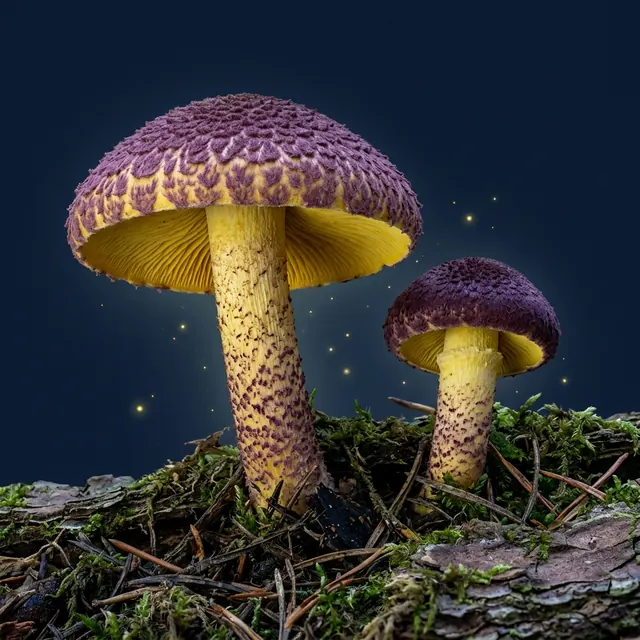
Plums and custard
Tricholomopsis rutilans
Polish folk names: złotawka, boczniak czerwonozłoty, bedłka czerwonozłota
How to recognise
- Cap 3–15 cm, delicately felty: yellow background covered with lilac-red scales; young ones are sometimes entirely purple.
- Gills fairly dense, always yellow, darker with age.
- Stem 5–12 cm tall and 1–3 cm thick, the colour of the cap, paler near the cap, soon hollow.
- Flesh yellow, smell and taste bland.
Up close
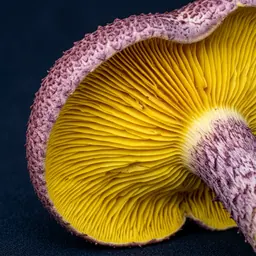 yellow gills
Underside of the cap
Gills bright yellow, fairly crowded, notched at the stem.
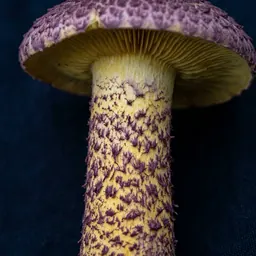 purple scales
Stem
Stem yellow with purple scales, like the cap; paler near the cap. No ring.
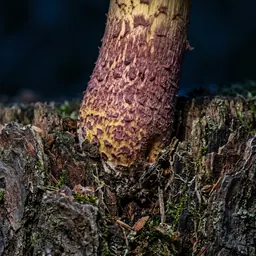 on a stump
Base of the stem
Grows from a stump or roots, singly or in tufts.
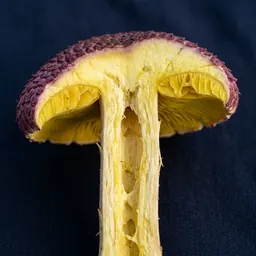 yellow flesh
Cross-section
Flesh yellow, stem quickly hollow. Smell insipid.
The close-ups are AI illustrations. Any doubt is settled by a mycologist or herbalist, not by a photo.
Where and when it grows
On trunks, stumps and dead wood, sometimes seemingly on the ground, on roots. In Central Europe mainly on coniferous trees. From July to November; common.
JanFebMarAprMayJunJulAugSepOctNovDec
Most often under: stumps and roots of coniferous trees.
Beware of the lookalike
Sulphur tuft. The sulphur tuft grows in dense clumps, has a sulphur-yellow cap without purple scales and greenish, then dark gills.
Good to know
It is not poisonous, but it is not very tasty and can cause stomach complaints, so we count it as inedible.
Frequently asked questions
Is plums and custard edible?
No, plums and custard is inedible. It is not poisonous, but it is not very tasty and can cause stomach complaints, so we count it as inedible.
When does plums and custard grow?
July – November. On trunks, stumps and dead wood, sometimes seemingly on the ground, on roots. In Central Europe mainly on coniferous trees. From July to November; common.
Plums and custard: what is it easily confused with?
Most often with the species Sulphur tuft. The sulphur tuft grows in dense clumps, has a sulphur-yellow cap without purple scales and greenish, then dark gills.