

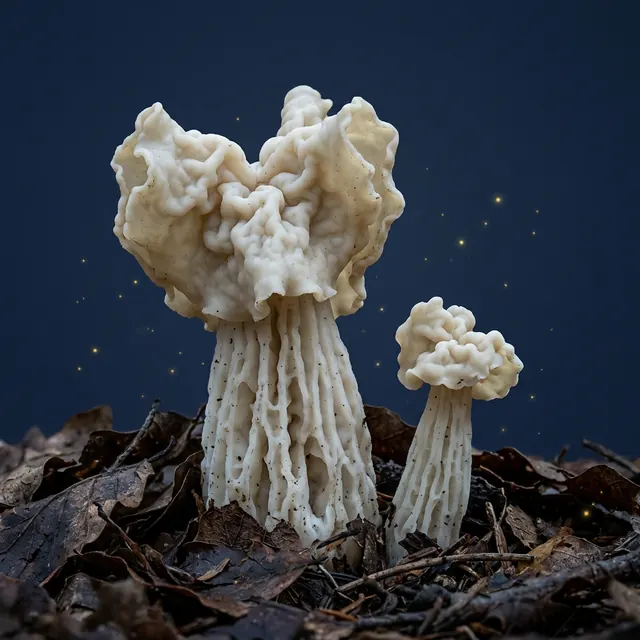
White saddle
Helvella crispa
How to recognise
- Fruiting body 2–10 cm (exceptionally up to 25 cm) tall, with a head and a stem.
- Head 2–5 cm, irregular, lobed, folded, sometimes saddle-shaped concave; whitish to cream-ochre.
- Stem 3–10 cm, distinctly longitudinally grooved and pitted, widened at the bottom, the same colour as the head.
- Flesh thin and brittle.
Up close
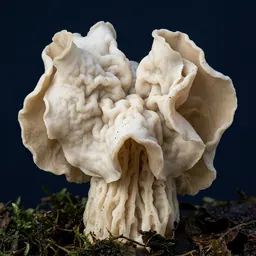 lobes and folds
Flower head
Head irregularly lobed and folded, whitish or cream, mossy underneath.
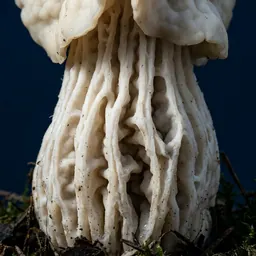 deep grooves
Stem
Stem with deep, lengthwise grooves and pits, like a ribbed column.
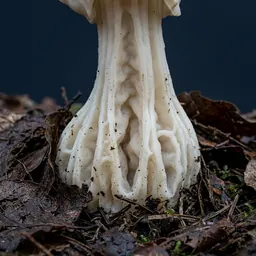 rozszerzona
Base of the stem
Stem widens downwards; grows straight from the ground, without a volva.
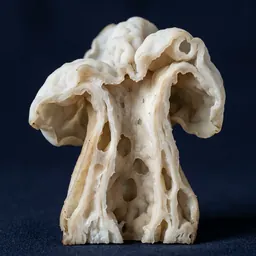 chambers in the stem
Cross-section
Flesh thin, brittle, whitish; the stem inside is divided into empty chambers.
The close-ups are AI illustrations. Any doubt is settled by a mycologist or herbalist, not by a photo.
Where and when it grows
Damp deciduous forests, fond of limestone soils, also parks, gardens and roadsides. From August to November; moderately common in Poland.
JanFebMarAprMayJunJulAugSepOctNovDec
Most often under: deciduous forests, especially with beech; parks, roadsides.
Beware of the lookalike
Piestrzyca giętka. Piestrzyca giętka is smaller, has a saddle-shaped head and a smooth stem without grooves and pits.
Good to know
Older atlases (including some Polish ones) list it as edible after cooking. Newer sources warn: the fruiting bodies contain or may contain methylhydrazines and gyromitrin, like false morels. There is no evidence that cooking removes these toxins. We advise against eating it.
Frequently asked questions
Is white saddle edible?
Nie. This mushroom is poisonous. Probably gyromitrin, which turns into methylhydrazine in the body (detailed analyses of this species are lacking). After eating raw fruiting bodies, gastrointestinal complaints have been described. In false morels, gyromitrin causes weakness, vomiting, headaches and abdominal pain after 6–24 hours, damages the liver and blood cells; it is also carcinogenic.
When does white saddle grow?
August – November. Damp deciduous forests, fond of limestone soils, also parks, gardens and roadsides. From August to November; moderately common in Poland.
White saddle: what is it easily confused with?
Most often with the species Piestrzyca giętka. Piestrzyca giętka is smaller, has a saddle-shaped head and a smooth stem without grooves and pits.