

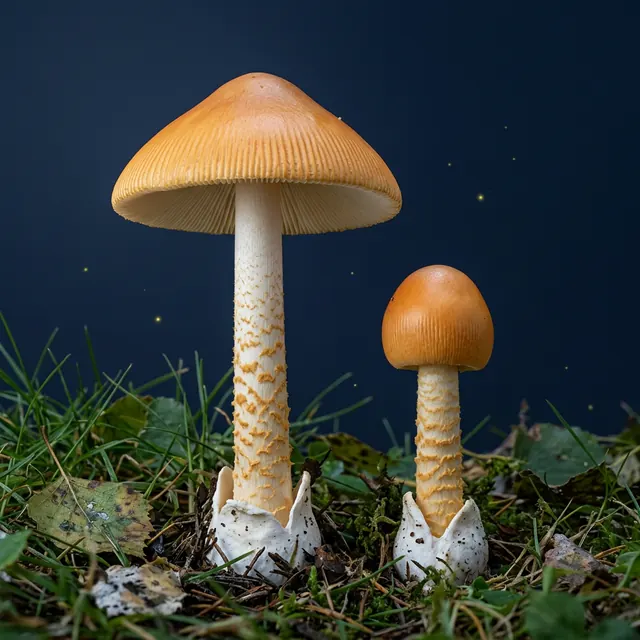
Amanita crocea
Amanita crocea
How to recognise
- Cap 6–15 cm, ochre-orange to yellow-orange, usually without remnants of the veil.
- Cap margin distinctly grooved for up to 1/3 of the radius; gills cream, free.
- Stem 10–15 cm, without a ring, with yellow-orange flakes on a white background.
- At the base a persistent, membranous volva, white outside and yellowish inside.
Up close
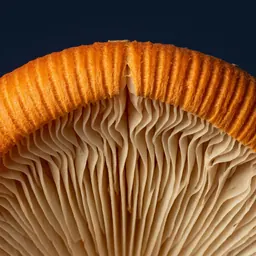 kremowe blaszki
Underside of the cap
Gills cream, fairly crowded, broad, free. Cap edge strongly striate.
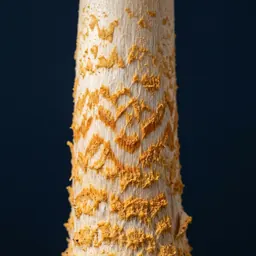 orange flakes
Stem
Stem tall, without a ring, covered with yellow-orange flakes on a white background.
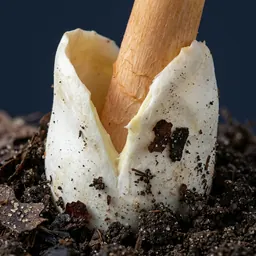 pochwa
Base of the stem
A persistent, membranous volva: white on the outside, yellowish on the inside.
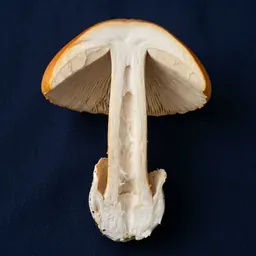 white flesh
Cross-section
Flesh white, thin, without smell. Stem cottony or hollow inside.
The close-ups are AI illustrations. Any doubt is settled by a mycologist or herbalist, not by a photo.
Where and when it grows
Deciduous and mixed forests, their edges, in grass, in warm and sunny places. In summer and autumn; rare in Poland.
JanFebMarAprMayJunJulAugSepOctNovDec
Most often under: deciduous and mixed forests, edges, in grass.
Beware of the lookalike
Tawny grisette. The tawny grisette is smaller, has a paler, rusty cap, whitish flakes on the stem and a volva with rusty patches.
Good to know
Considered edible, but easily confused with poisonous amanitas, and it is rare in Poland. Do not collect it.
Frequently asked questions
Is amanita crocea edible?
No, amanita crocea is inedible. Considered edible, but easily confused with poisonous amanitas, and it is rare in Poland. Do not collect it.
When does amanita crocea grow?
July – September. Deciduous and mixed forests, their edges, in grass, in warm and sunny places. In summer and autumn; rare in Poland.
Amanita crocea: what is it easily confused with?
Most often with the species Tawny grisette. The tawny grisette is smaller, has a paler, rusty cap, whitish flakes on the stem and a volva with rusty patches.