

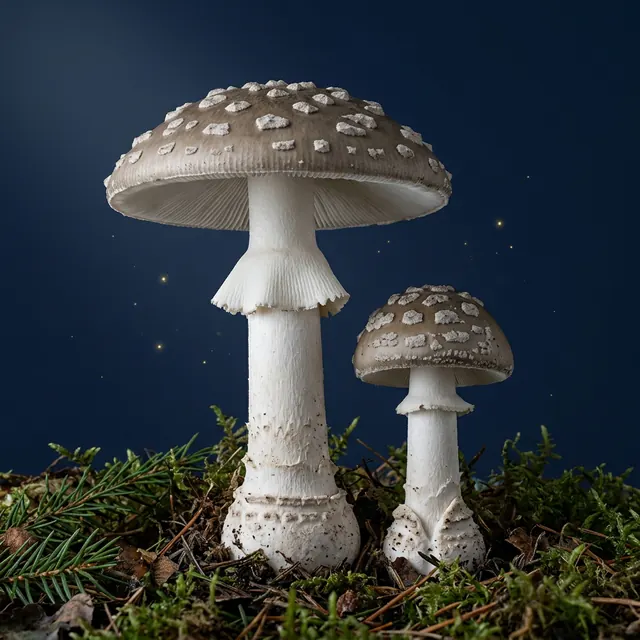
Grey spotted amanita
Amanita excelsa
Polish folk names: bedłka twardawa, bedłka silna
How to recognise
- Cap 5–15 cm, grey-brown or brown-ashy, with paler, whitish-grey patches that rain can wash off.
- Cap margin without grooves; gills white, dense, free.
- Stem 6–15 cm tall and 2–3 cm thick, with a large, whitish ring that is grooved on the upper side.
- At the base a large, pointed bulb up to 4.5 cm wide, with warty rims, without a distinct volva.
Up close
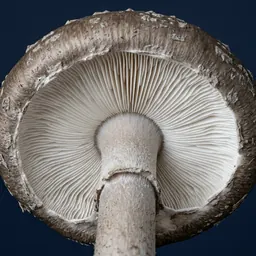 white gills
Underside of the cap
Gills white, crowded, free, not attached to the stem.
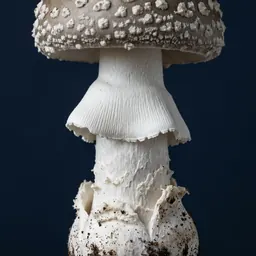 grooved ring
Stem
Stem whitish, breaks easily. The large, whitish ring is grooved (striate) on the upper side.
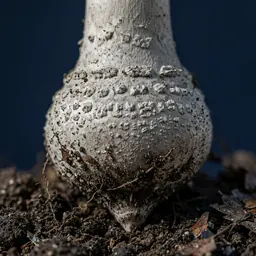 bulwa bez pochwy
Base of the stem
A large, pointed bulb with several warty rims, without a free volva.
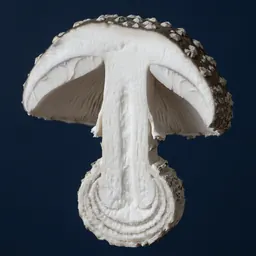 greyish under the skin
Cross-section
Flesh white, greyish under the cap skin; does not change colour. Smell earthy, sometimes like radish.
The close-ups are AI illustrations. Any doubt is settled by a mycologist or herbalist, not by a photo.
Where and when it grows
Mainly coniferous forests, less often deciduous, usually in groups. In summer and autumn, also during drought; common in Poland.
JanFebMarAprMayJunJulAugSepOctNovDec
Most often under: coniferous forests, less often deciduous.
Beware of the lookalike
Panther cap. The panther cap has a striate cap margin, a smooth ring and a bulb with a rim of ridges. Confusion is dangerous, so do not pick the grey spotted amanita.
Feature-by-feature comparison: Grey spotted amanita or Panther cap?
Good to know
Given in the literature as edible, but of little value. It is easily confused with the poisonous panther cap, so we advise against collecting it.
Frequently asked questions
Is grey spotted amanita edible?
No, grey spotted amanita is inedible. Given in the literature as edible, but of little value. It is easily confused with the poisonous panther cap, so we advise against collecting it.
When does grey spotted amanita grow?
June – October. Mainly coniferous forests, less often deciduous, usually in groups. In summer and autumn, also during drought; common in Poland.
Grey spotted amanita: what is it easily confused with?
Most often with the species Panther cap. The panther cap has a striate cap margin, a smooth ring and a bulb with a rim of ridges. Confusion is dangerous, so do not pick the grey spotted amanita.