

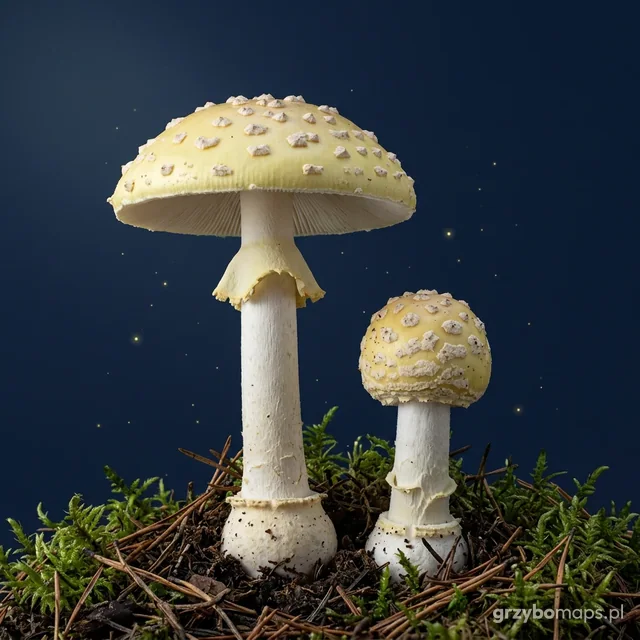
False death cap
Amanita citrina
How to recognise
- Cap pale lemon or white, covered with patches of veil remnants.
- Gills and flesh white, the flesh smells of raw potatoes.
- A hanging, yellowish ring on the stem.
- At the base a round bulb with a distinct, sharp edge (not a loose sac).
Up close
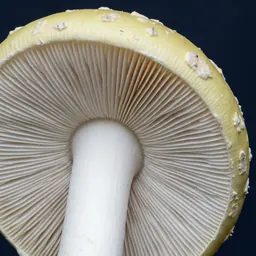 white gills
Underside of the cap
Gills white, free.
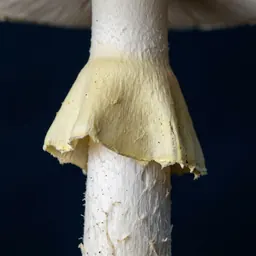 ring
Stem
A hanging, yellowish ring on the stem.
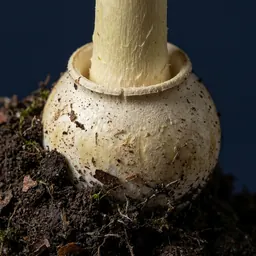 bulb with a rim
Base of the stem
Round bulb with a sharp edge – not a loose sack. Always twist out the whole mushroom.
 zapach ziemniaka
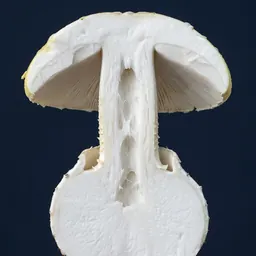
Cross-section
Flesh white, smells of raw potatoes.
The close-ups are AI illustrations. Any doubt is settled by a mycologist or herbalist, not by a photo.
Where and when it grows
Very common in coniferous and deciduous forests, especially on sandy, acidic soils; from July to November.
JanFebMarAprMayJunJulAugSepOctNovDec
Most often under: pine, spruce, beech, oak, birch.
Beware of the lookalike
Death cap. The death cap has a greenish, usually smooth cap, a bag-like sheath at the base and does not smell of potatoes. If you have any doubt at all, treat both as deadly.
Feature-by-feature comparison: False death cap or Death cap?
Good to know
Sources differ: most often described as inedible, some give it as mildly poisonous – that is why it is marked as poisonous. The greatest danger is confusing it with the death cap.
Where in Poland
Most records in the GBIF database: łódzkie, mazowieckie, wielkopolskie, zachodniopomorskie, pomorskie.
Frequently asked questions
Is false death cap edible?
Nie. This mushroom is poisonous. Contains bufotenine and related compounds; poisonings are rare and usually mild (stomach complaints). The real danger is confusion with the deadly death cap.
When does false death cap grow?
July – November. Very common in coniferous and deciduous forests, especially on sandy, acidic soils; from July to November.
False death cap: what is it easily confused with?
Most often with the species Death cap. The death cap has a greenish, usually smooth cap, a bag-like sheath at the base and does not smell of potatoes. If you have any doubt at all, treat both as deadly.
Where in Poland does false death cap grow?
Most records (GBIF): łódzkie, mazowieckie, wielkopolskie, zachodniopomorskie, pomorskie. Most often under: pine, spruce, beech, oak, birch.