


Brick tuft
Hypholoma lateritium
How to recognise
- Grows in dense clumps on stumps and roots of deciduous trees.
- Cap brick-red, yellowish towards the edge, with whitish remnants of the cortina on the edge.
- Gills first yellowish, then grey-olive to violet-brown.
- Flesh yellowish, taste slightly bitter.
Up close
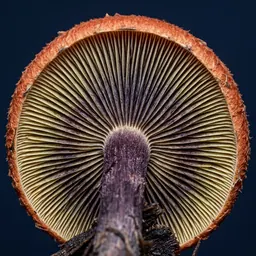 oliwkowe blaszki
Underside of the cap
Gills yellowish, then grey-olive to violet-brown.
 no ring
Stem
Stem yellowish, rusty at the bottom, without a ring.
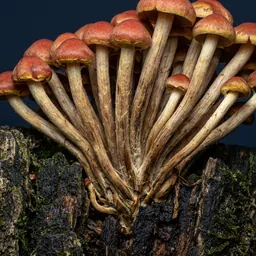 clumps on a stump
Base of the stem
Dense clumps on stumps of deciduous trees.
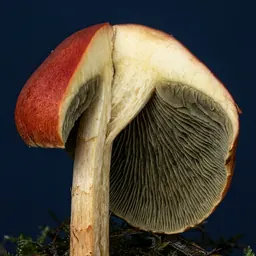 gorzki
Cross-section
Flesh yellowish, taste slightly bitter.
The close-ups are AI illustrations. Any doubt is settled by a mycologist or herbalist, not by a photo.
Where and when it grows
Common on stumps of oaks, beeches and other deciduous trees; mainly from September to November.
JanFebMarAprMayJunJulAugSepOctNovDec
Most often under: oak, beech, hornbeam (stumps of broadleaved trees).
Beware of the lookalike
Honey fungus. The honey fungus has a white, membranous ring, white or cream gills and dark scales on the cap. The brick tuft has a smooth cap, grey-olive to violet-black gills and only a trace of a veil.
Good to know
In Poland and Europe inedible because of its bitterness (which does not disappear with cooking); it can cause gastrointestinal disorders, and some sources consider it poisonous – that is why it is marked as poisonous. In Japan and the USA it is sometimes eaten.
Where in Poland
Most records in the GBIF database: wielkopolskie, zachodniopomorskie, śląskie, łódzkie, małopolskie.
Frequently asked questions
Is brick tuft edible?
Nie. This mushroom is poisonous. Gastrointestinal disorders (nausea, vomiting, diarrhoea) within a few hours; toxins poorly understood.
When does brick tuft grow?
August – November. Common on stumps of oaks, beeches and other deciduous trees; mainly from September to November.
Brick tuft: what is it easily confused with?
Most often with the species Honey fungus. The honey fungus has a white, membranous ring, white or cream gills and dark scales on the cap. The brick tuft has a smooth cap, grey-olive to violet-black gills and only a trace of a veil.
Where in Poland does brick tuft grow?
Most records (GBIF): wielkopolskie, zachodniopomorskie, śląskie, łódzkie, małopolskie. Most often under: oak, beech, hornbeam (stumps of broadleaved trees).