

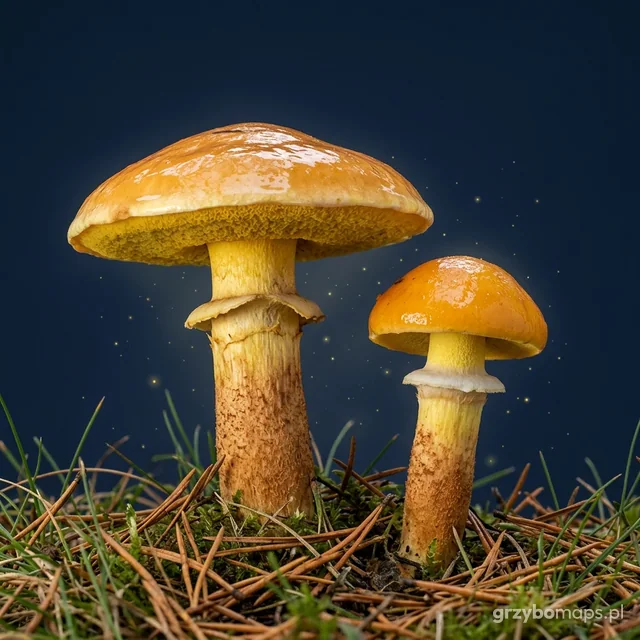
Larch bolete
Suillus grevillei
Polish folk names: maślak modrzewiowy, grzyb modrzewiowy
How to recognise
- Cap golden-yellow to golden-orange, paler at the edge, slimy.
- Tubes and pores yellow.
- Stem with a whitish-yellow, membranous ring.
- Flesh yellow, does not change colour or turns slightly pink.
Up close
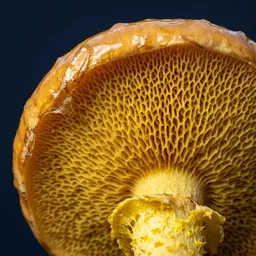 yellow tubes
Underside of the cap
Pores fine, yellow, slightly decurrent.
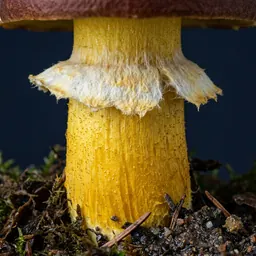 ring
Stem
Stem with a whitish-yellow, membranous ring.
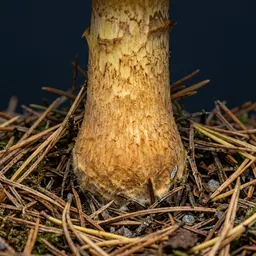 pod modrzewiem
Base of the stem
Base without a volva; grows only under larches.
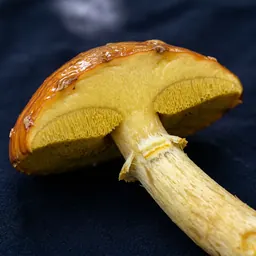 does not turn blue
Cross-section
Flesh yellow, does not change colour or turns slightly pink.
The close-ups are AI illustrations. Any doubt is settled by a mycologist or herbalist, not by a photo.
Where and when it grows
Only under larches – in forests, parks and tree stands. From June to October.
JanFebMarAprMayJunJulAugSepOctNovDec
Most often under: modrzew.
Beware of the lookalike
Slippery jack. The slippery jack has a brown cap and grows under pines; the larch bolete is golden-orange and grows only under larches. Both are edible.
In the kitchen
Peel off the slimy skin before preparing; good for frying, soups and pickles.
Where in Poland
Most records in the GBIF database: małopolskie, wielkopolskie, pomorskie, dolnośląskie, zachodniopomorskie.
Recipes with this mushroom
Frequently asked questions
Is larch bolete edible?
Yes, larch bolete is an edible mushroom.
When does larch bolete grow?
June – October. Only under larches – in forests, parks and tree stands. From June to October.
Larch bolete: what is it easily confused with?
Most often with the species Slippery jack. The slippery jack has a brown cap and grows under pines; the larch bolete is golden-orange and grows only under larches. Both are edible.
Where in Poland does larch bolete grow?
Most records (GBIF): małopolskie, wielkopolskie, pomorskie, dolnośląskie, zachodniopomorskie. Most often under: modrzew.