

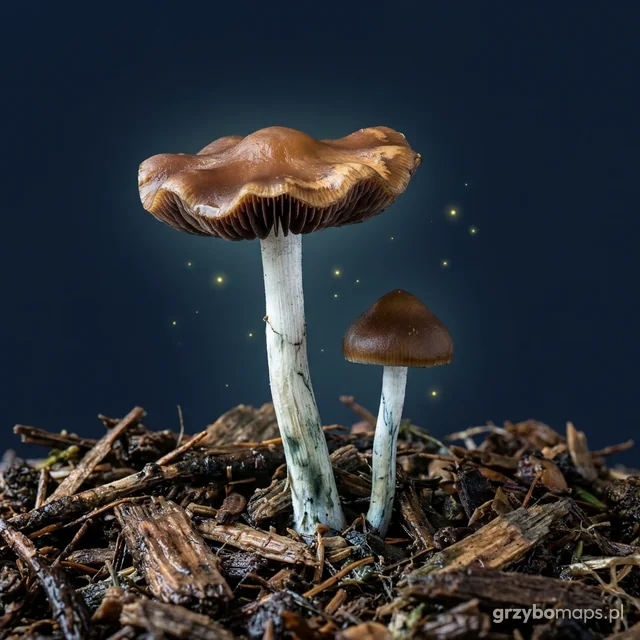
Wavy cap
Psilocybe cyanescens
How to recognise
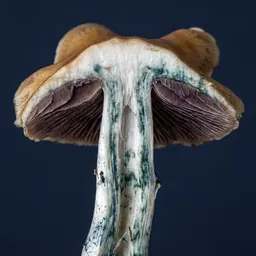
- Cap 2–5 cm, chestnut-brown, tawny to yellowish when dry; edge distinctly wavy.
- All parts turn blue (blue-green patches) when damaged or with age.
- Gills brown, then violet-brown; spore print dark, violet-brown.
- Stem whitish, fibrous, usually grows in dense groups.
Up close
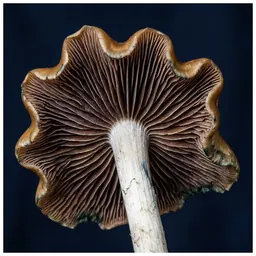 violet-brown gills
Underside of the cap
Gills brown, then violet-brown; cap edge wavy.
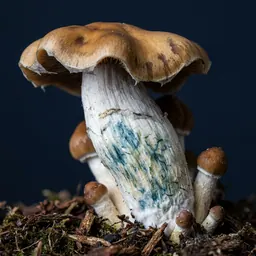 sinieje
Stem
Stem whitish, fibrous; blue-green stains when damaged.
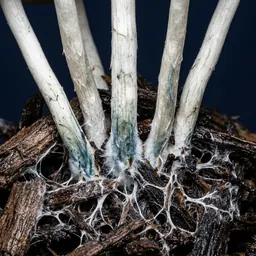 on wood chips
Base of the stem
Grows in groups on wood chips and wood debris; white cords of mycelium at the base.
 sinieje
Cross-section
Flesh whitish, turns blue when damaged.
The close-ups are AI illustrations. Any doubt is settled by a mycologist or herbalist, not by a photo.
Where and when it grows
An introduced species spreading in Europe: wood chips and bark on flower beds in cities, parks, gardens. Rarely recorded in Poland. Autumn to early winter (September–December).
JanFebMarAprMayJunJulAugSepOctNovDec
Most often under: none – wood chips and bark (mulch in flower beds), wood debris.
Beware of the lookalike
Funeral bell. Galerina grows in similar places (wood, wood chips), has rusty-brown gills and a ring, and does not bruise blue when pressed; contains deadly amanitins.
Law
Psilocybin and psilocin are psychotropic substances in Poland (Act on Counteracting Drug Addiction, group I-P); possession of mushrooms containing them is punishable.
Where in Poland
Most records in the GBIF database: małopolskie.
Frequently asked questions
Is wavy cap edible?
Nie. This mushroom is poisonous. Psilocybin (converted to psilocin in the body). Symptoms usually after 20–60 min: dilated pupils, nausea, palpitations, perception disturbances and hallucinations, anxiety; they usually subside after about 4–6 h. Symptoms appearing only after 6 h or later suggest a mix-up with a mushroom containing amanitins (Galerina, Conocybe) – then go to hospital immediately.
When does wavy cap grow?
September – December. An introduced species spreading in Europe: wood chips and bark on flower beds in cities, parks, gardens. Rarely recorded in Poland. Autumn to early winter (September–December).
Wavy cap: what is it easily confused with?
Most often with the species Funeral bell. Galerina grows in similar places (wood, wood chips), has rusty-brown gills and a ring, and does not bruise blue when pressed; contains deadly amanitins.
Where in Poland does wavy cap grow?
Most records (GBIF): małopolskie. Most often under: none – wood chips and bark (mulch in flower beds), wood debris.