

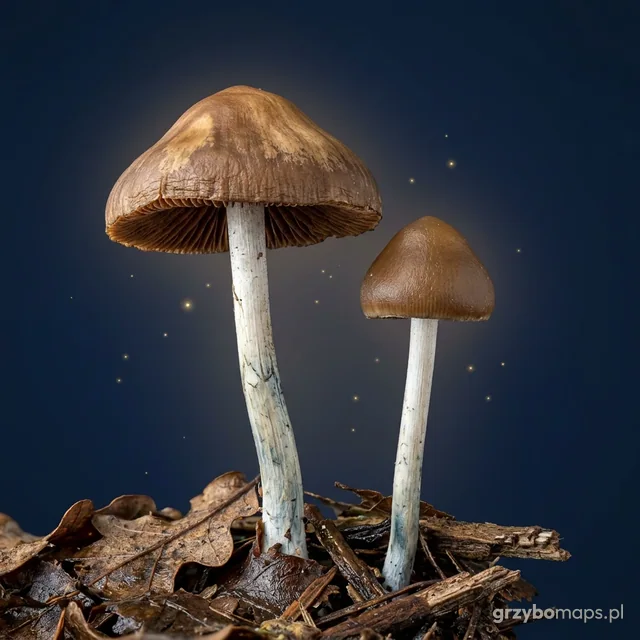
Psilocybe serbica
Psilocybe serbica
Polish folk names: łysiczka czeska (odmiana bohemica)
Psilocybe serbica is a small, bluing mushroom that grows on rotting twigs and wood debris in the forests of Central Europe and the Balkans. It was described in 1969 from Serbia, which gave it its name. It contains psilocybin, so it is poisonous, and possessing it is illegal in Poland. We describe it so that every forager can recognise it and never confuse it with the deadly poisonous Galerina.
How to recognise
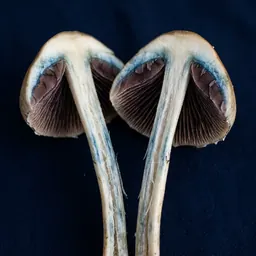
- Cap 1–4 cm, bell-shaped to flat, hygrophanous: brown when wet, tawny-brown when dry.
- Flesh whitish to cream, turning blue when crushed or cut.
- Gills adnate, brown, spore print violet-brown.
- Stem thin, whitish, turning blue at the base.
Up close
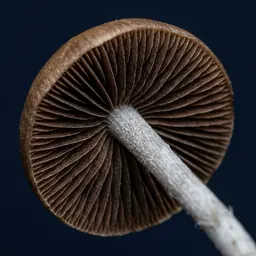 brown gills
Underside of the cap
Gills adnate, brown; spore print violet-brown.
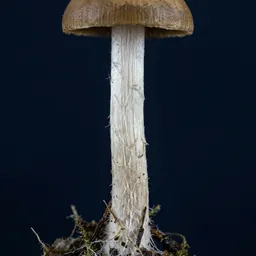 thin, white
Stem
Stem thin, whitish, fibrous, without a ring.
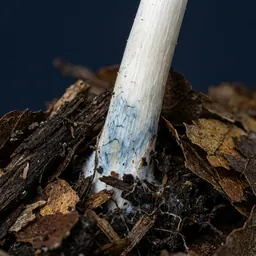 sinieje
Base of the stem
Base turns blue; grows on wood debris and leaf litter.
 niebieszczeje
Cross-section
Flesh whitish to cream, turning blue when crushed or cut.
The close-ups are AI illustrations. Any doubt is settled by a mycologist or herbalist, not by a photo.
Where and when it grows
Deciduous and mixed forests, on rotting wood, twigs and leaf litter, also on compost and verges. In Poland the variety bohemica is known from a single site (near Lubawka). Autumn.
JanFebMarAprMayJunJulAugSepOctNovDec
Most often under: none – rotting wood, twigs, leaf litter in deciduous forests.
Beware of the lookalike
Funeral bell. Galerina has rusty-brown gills, a ring or a fibrous zone on the stem and does not bruise blue; the psilocybe has violet-brown spores and bruises blue.
Law
Psilocybin and psilocin are psychotropic substances in Poland (Act on Counteracting Drug Addiction, group I-P); possession of mushrooms containing them is punishable.
Where in Poland
Most records in the GBIF database: śląskie.
Frequently asked questions
Is psilocybe serbica edible?
Nie. This mushroom is poisonous. Psilocybin (converted to psilocin in the body). Symptoms usually after 20–60 min: dilated pupils, nausea, palpitations, perception disturbances and hallucinations, anxiety; they usually subside after about 4–6 h. Symptoms appearing only after 6 h or later suggest a mix-up with a mushroom containing amanitins (Galerina, Conocybe) – then go to hospital immediately.
When does psilocybe serbica grow?
September – November. Deciduous and mixed forests, on rotting wood, twigs and leaf litter, also on compost and verges. In Poland the variety bohemica is known from a single site (near Lubawka). Autumn.
Psilocybe serbica: what is it easily confused with?
Most often with the species Funeral bell. Galerina has rusty-brown gills, a ring or a fibrous zone on the stem and does not bruise blue; the psilocybe has violet-brown spores and bruises blue.
Where in Poland does psilocybe serbica grow?
Most records (GBIF): śląskie. Most often under: none – rotting wood, twigs, leaf litter in deciduous forests.
What is Psilocybe serbica called in other languages?
Its Latin name is Psilocybe serbica, in German it is Serbischer Kahlkopf, in Polish łysiczka serbska and in Czech lysohlávka srbská. Its variety bohemica is called lysohlávka česká in Czech and łysiczka czeska in Polish.
Does Psilocybe serbica grow in Poland?
Very rarely. In Poland the variety bohemica is known from a single site near Lubawka, described in the journal Acta Mycologica in 2018. It is found more often in the Czech Republic and Austria.
How does Psilocybe serbica differ from the liberty cap?
The liberty cap grows in grass on meadows and pastures, and its cap is conical with a sharp, pointed tip. Psilocybe serbica grows in woodland on wood debris, and its cap is bell-shaped, becoming almost flat with age.
Is Psilocybe serbica legal in Poland?
No. In Poland psilocybin and psilocin are psychotropic substances in group I-P of the Act on Counteracting Drug Addiction, and possessing mushrooms that contain them is a criminal offence.