

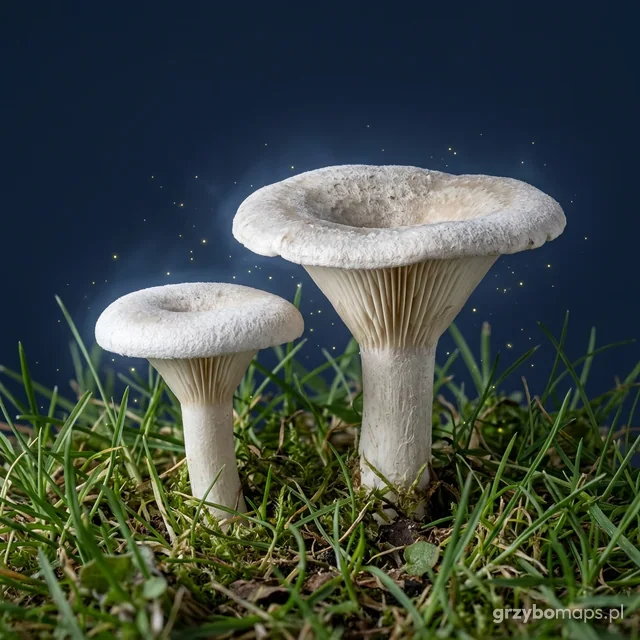
Fool's funnel
Clitocybe rivulosa
Polish folk names: lejkówka strumykowa
How to recognise
- Cap 2–5 cm, whitish to grey-beige, with a white, frosted bloom, later slightly concave.
- Gills dense, whitish, shortly running down the stem.
- Stem short, whitish, brittle.
- Grows in clusters in grass, often in rings, together with the fairy ring champignon.
Up close
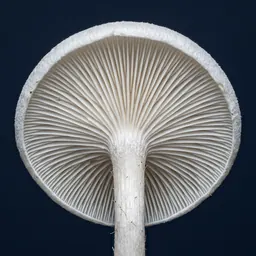 decurrent gills
Underside of the cap
Gills dense, whitish, running down the stem (the fairy ring champignon has sparse, free ones).
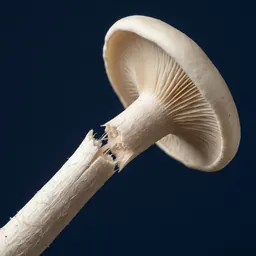 short
Stem
Stem short, whitish, brittle – it does not twist like that of the fairy ring champignon.
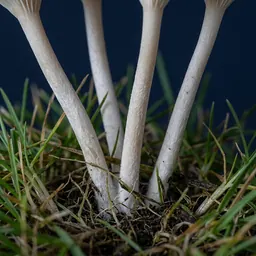 w trawie
Base of the stem
Grows in groups in grass, often in rings. Always twist out the whole mushroom.
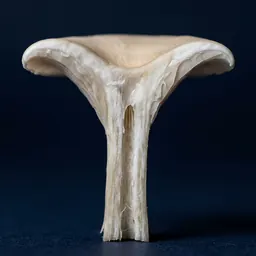 thin flesh
Cross-section
Flesh thin, whitish, does not change colour.
The close-ups are AI illustrations. Any doubt is settled by a mycologist or herbalist, not by a photo.
Where and when it grows
Meadows, pastures, lawns, roadsides and forest edges; from August to November.
JanFebMarAprMayJunJulAugSepOctNovDec
Most often under: none – meadows, lawns, pastures.
Beware of the lookalike
Fairy ring champignon. The fairy ring champignon has sparse, thick gills free from the stem and a very flexible stem that can be twisted without breaking. The funnel cap has crowded gills running down the stem and a brittle stem.
Feature-by-feature comparison: Fairy ring champignon or Fool's funnel?
Good to know
Nomenclature: in 2025 the Commission for Polish Fungal Names assigned the name "lejkówka jadowita" to Clitocybe rivulosa, and named C. dealbata "lejkówka strumykowa" (previously the other way round, or treated as one species). Both are poisonous. Newer scientific name: Collybia rivulosa.
Where in Poland
Most records in the GBIF database: wielkopolskie, dolnośląskie, łódzkie, kujawsko-pomorskie, lubelskie.
Frequently asked questions
Is fool's funnel edible?
Nie. This mushroom is poisonous. Muscarine. Symptoms after 15 min–4 h: profuse sweating, drooling, tearing, constricted pupils, visual disturbances, vomiting, diarrhoea, drop in blood pressure and slow heart rate. Antidote: atropine; deaths are rare.
When does fool's funnel grow?
August – November. Meadows, pastures, lawns, roadsides and forest edges; from August to November.
Fool's funnel: what is it easily confused with?
Most often with the species Fairy ring champignon. The fairy ring champignon has sparse, thick gills free from the stem and a very flexible stem that can be twisted without breaking. The funnel cap has crowded gills running down the stem and a brittle stem.
Where in Poland does fool's funnel grow?
Most records (GBIF): wielkopolskie, dolnośląskie, łódzkie, kujawsko-pomorskie, lubelskie. Most often under: none – meadows, lawns, pastures.