

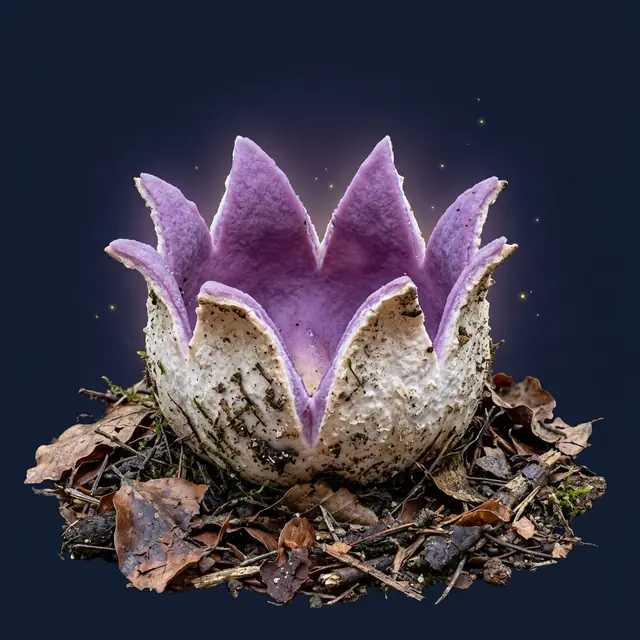
Violet crown-cup
Sarcosphaera coronaria
Polish folk names: koronica
How to recognise
- When young it grows underground as a closed, hollow ball.
- After emerging at the surface it splits from the top into 5–10 triangular lobes, like a crown or a star.
- Inside lilac to violet, outside whitish, often caked with soil.
- Diameter 5–15 cm, flesh brittle and fragile.
Where and when it grows
Deciduous and coniferous forests on calcareous soils, especially beech woods and pine forests. From April to June.
JanFebMarAprMayJunJulAugSepOctNovDec
Most often under: forests on calcareous soils, under beeches, pines and firs.
Beware of the lookalike
Blistered cup. The blistered cup has a pale brown inside and grows on dung. The violet crown-cup has a violet inside, a white outer side and a rim that splits into a star.
Good to know
Poisonous: raw it can kill, and even after cooking it damages the liver. It accumulates arsenic from the soil. In Poland it is under strict protection and listed on the Red List, so it must not be picked. Take a photo and leave it.
Frequently asked questions
Is violet crown-cup edible?
Nie. This mushroom is poisonous.
When does violet crown-cup grow?
April – June. Deciduous and coniferous forests on calcareous soils, especially beech woods and pine forests. From April to June.
Violet crown-cup: what is it easily confused with?
Most often with the species Blistered cup. The blistered cup has a pale brown inside and grows on dung. The violet crown-cup has a violet inside, a white outer side and a rim that splits into a star.