

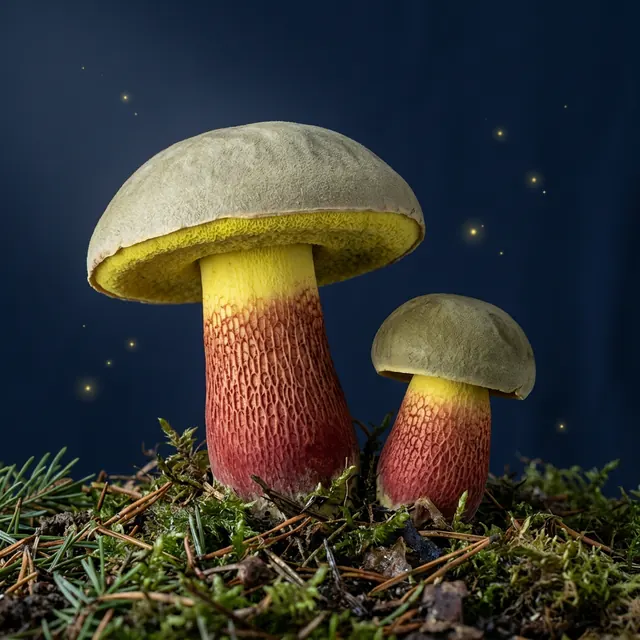
Bitter beech bolete
Caloboletus calopus
Polish folk names: borowik żółtopory, borowik grubotrzonowy, goryczak, wścieklak
How to recognise
- Cap 3–15 cm, light brown to grey-olive, suede-like, with the margin inrolled for a long time.
- Pores small, lemon-yellow, later olive, turn blue when crushed.
- Stem 7–14 cm tall and 2–4.5 cm thick, yellow above, carmine-red below, entirely reticulate.
- Flesh cream, blue-green when cut, bitter in taste.
Where and when it grows
Mountain spruce forests and deciduous forests on acidic soils, under spruces, beeches and oaks. In summer and autumn; in Poland more often in the south, in the lower parts of the mountains.
JanFebMarAprMayJunJulAugSepOctNovDec
Most often under: spruce, beech, oak (mountains, acidic soils).
Beware of the lookalike
Rooting bitter bolete. The rooting bolete also has a pale cap and yellow pores, but a yellowish stem, without red and with a barely visible net.
Feature-by-feature comparison: Bitter beech bolete or Rooting bitter bolete?
Frequently asked questions
Is bitter beech bolete edible?
Nie. This mushroom is poisonous. Inedible because of a very bitter taste that does not disappear when cooked; some sources consider it poisonous. Eating it can cause severe gastrointestinal complaints that appear after about 20 minutes and last up to 2 days.
When does bitter beech bolete grow?
July – October. Mountain spruce forests and deciduous forests on acidic soils, under spruces, beeches and oaks. In summer and autumn; in Poland more often in the south, in the lower parts of the mountains.
Bitter beech bolete: what is it easily confused with?
Most often with the species Rooting bitter bolete. The rooting bolete also has a pale cap and yellow pores, but a yellowish stem, without red and with a barely visible net.