

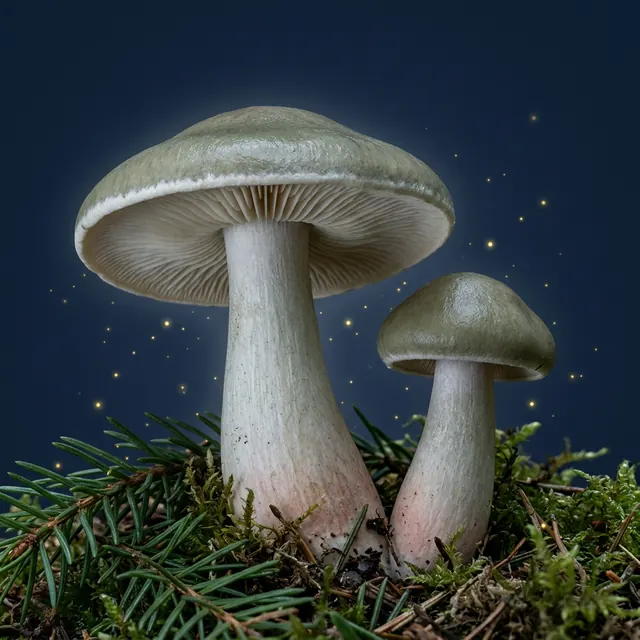
Soap-scented toadstool
Tricholoma saponaceum
Polish folk names: bedłka mydlana
How to recognise
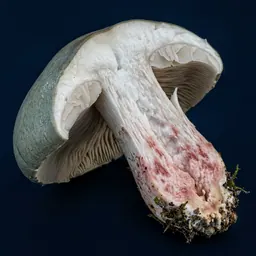
- Cap 5–10 cm, smooth, with an inrolled margin for a long time, usually grey-green, but from white to blackish-brown.
- Gills widely spaced, white, then yellowish-grey, blacken when damaged.
- Stem 6–10 cm, cylindrical or spindle-shaped, pointed at the base, paler than the cap.
- Flesh whitish, reddish at the stem base, turns red with time; soapy smell.
Up close
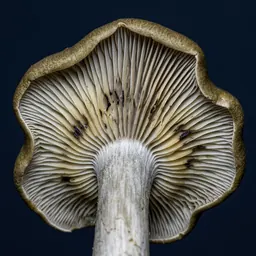 rzadkie blaszki
Underside of the cap
Gills widely spaced, notched with a tooth, white to yellow-grey; they turn black when damaged.
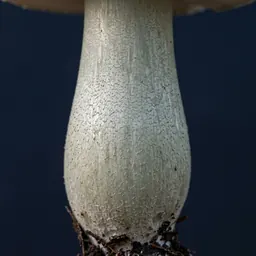 wrzecionowaty
Stem
Stem spindle-shaped, pointed at the bottom, smooth or finely scaly, paler than the cap.
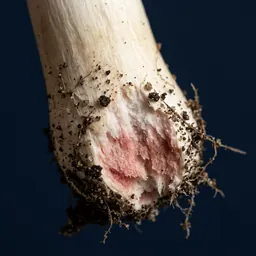 czerwienieje
Base of the stem
Base narrowed, without a bulb or volva; the flesh there is reddish.
 soapy smell
Cross-section
Flesh whitish, turning pink or red after a few hours, especially in the stem. A distinct soapy smell.
The close-ups are AI illustrations. Any doubt is settled by a mycologist or herbalist, not by a photo.
Where and when it grows
Coniferous and mixed forests, under firs and pines, sometimes in groups. From September to November.
JanFebMarAprMayJunJulAugSepOctNovDec
Most often under: pine, fir, spruce; also oak.
Beware of the lookalike
Streaked tricholoma. The gąska niekształtna has a grey-brown, radially fibrous cap with a yellowish tinge and a mealy smell. The soap-scented toadstool smells of soap and turns red at the base.
Frequently asked questions
Is soap-scented toadstool edible?
Nie. This mushroom is poisonous. Gastrointestinal toxins. Undercooked or eaten in larger amounts, it causes nausea, vomiting and diarrhea.
When does soap-scented toadstool grow?
September – November. Coniferous and mixed forests, under firs and pines, sometimes in groups. From September to November.
Soap-scented toadstool: what is it easily confused with?
Most often with the species Streaked tricholoma. The gąska niekształtna has a grey-brown, radially fibrous cap with a yellowish tinge and a mealy smell. The soap-scented toadstool smells of soap and turns red at the base.