

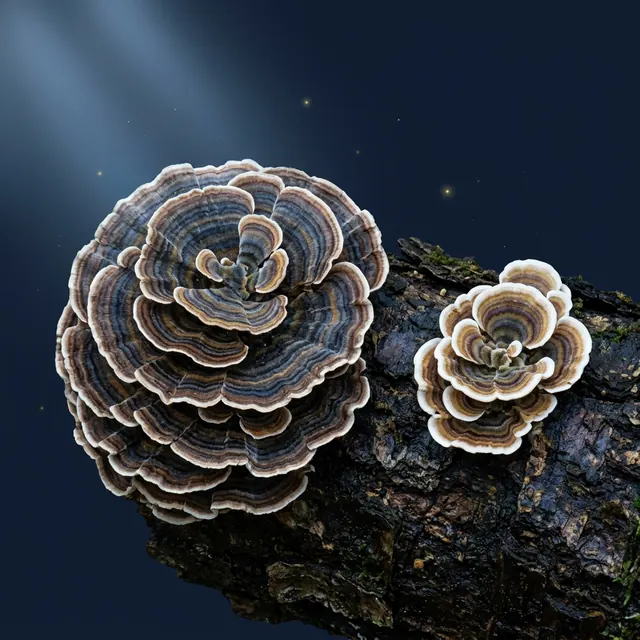
Turkey tail
Trametes versicolor
Polish folk names: huba różnokolorowa, hubczak różnobarwny, hubka różnobarwna, skórzak różnobarwny, żagiew różnobarwna
How to recognise
- Fruiting body thin (2–5 mm) and 3–8 cm wide, bracket-like or rosette-like, leathery and flexible.
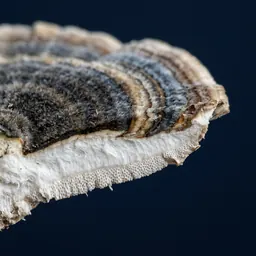
- Upper surface silky-shiny, short-haired, with distinct concentric zones from brown through blue to black; margin sharp and pale.
- Underside cream, light brown in older ones, with fine pores 0.15–0.4 mm.
- Grows in groups, the fruiting bodies overlapping like roof tiles; old ones often have a green coating of algae.
Up close
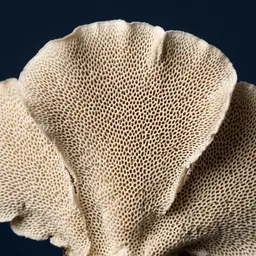 drobne pory
Underside of the fruiting body
Cream underside with small, round or angular pores; it is not smooth.
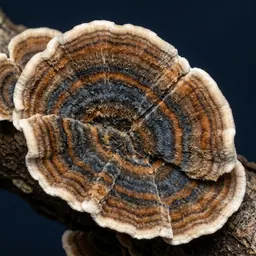 barwne pasy
Top
Velvety, shiny top with concentric bands of brown, blue, grey and black.
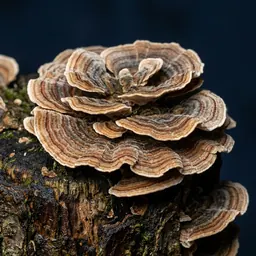 like roof tiles
Attachment to wood
Many thin brackets attached sideways, one above another, on a dead trunk or stump.
 thin, white
Cross-section
Flesh white, very thin (2–5 mm) and elastic; tube layer 0.5–2 mm.
The close-ups are AI illustrations. Any doubt is settled by a mycologist or herbalist, not by a photo.
Where and when it grows
Dead trunks, stumps and branches of deciduous trees, rarely coniferous, in forests, thickets, parks and gardens. All year round; very common.
JanFebMarAprMayJunJulAugSepOctNovDec
Most often under: beech, oak, birch, hornbeam and many other deciduous trees (dead trunks, stumps, branches).
Beware of the lookalike
Hairy curtain crust. Skórnik szorstki has a similar top, but a completely smooth underside, without pores. Wrośniak strefowany is thicker, matt and less colourful.
Good to know
In Europe it is considered inedible because it is stringy. The polysaccharide PSK (krestin) is obtained from the fruiting bodies and used in some countries as an adjunct in the treatment of some cancers; it does not replace treatment.
Frequently asked questions
Is turkey tail edible?
No, turkey tail is inedible. In Europe it is considered inedible because it is stringy. The polysaccharide PSK (krestin) is obtained from the fruiting bodies and used in some countries as an adjunct in the treatment of some cancers; it does not replace treatment.
When does turkey tail grow?
January – December. Dead trunks, stumps and branches of deciduous trees, rarely coniferous, in forests, thickets, parks and gardens. All year round; very common.
Turkey tail: what is it easily confused with?
Most often with the species Hairy curtain crust. Skórnik szorstki has a similar top, but a completely smooth underside, without pores. Wrośniak strefowany is thicker, matt and less colourful.