

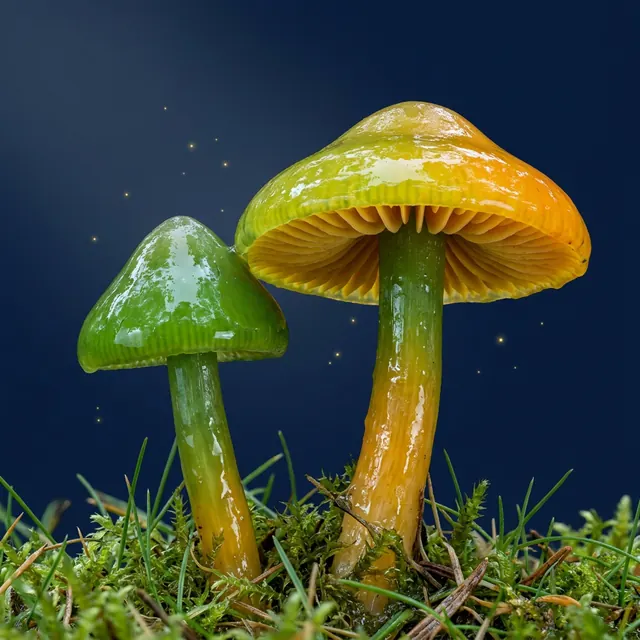
Parrot waxcap
Gliophorus psittacinus
Polish folk names: wilgotnica papuzia, wodnica papuzia, wodnicha żywobarwna
How to recognise
- Cap 1–4 cm, conical or bell-shaped, later with a blunt umbo, very strongly slimy.
- Colour grass-green, then yellow-green, orange-yellow to orange-brown.
- Gills thick, distant, yellow to orange, greenish in older specimens.
- Stem 3–7 cm, hollow, very slimy, green at the top, yellow or orange below.
Up close
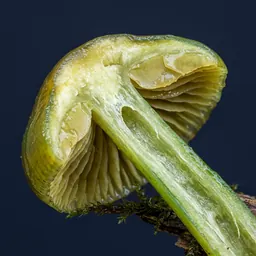
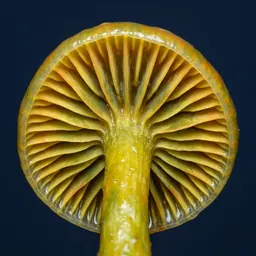 yellow, then greenish
Underside of the cap
Gills thick, distant, broad, yellow to orange, greenish in older ones.
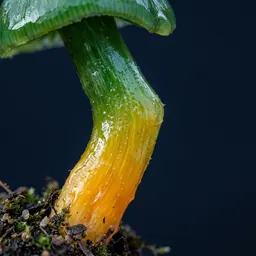 green-yellow slime
Stem
Stem smooth, shiny, very slimy: green at the top, yellow or orange below.
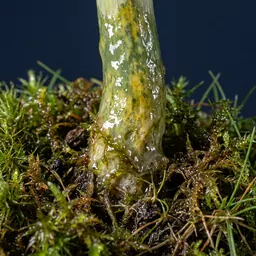 w darni
Base of the stem
Base straight, growing from grass or moss in an unfertilised meadow.
 brittle flesh
Cross-section
Flesh very brittle, white with a yellow, greenish or orange tinge; stem hollow.
The close-ups are AI illustrations. Any doubt is settled by a mycologist or herbalist, not by a photo.
Where and when it grows
Unfertilised pastures, meadows, lawns, forest edges, forest tracks. From May to mid-November; rare in Poland.
JanFebMarAprMayJunJulAugSepOctNovDec
Most often under: unfertilised meadows, pastures, forest edges.
Beware of the lookalike
Dzwonkówka brązowozielona. Dzwonkówka brązowozielona has no yellow-orange shades or thick layer of slime, and its gills turn pink with age.
Good to know
Inedible. On the Red List of Fungi of Poland it has the status R (potentially threatened). It is an indicator of old, unfertilised meadows.
Frequently asked questions
Is parrot waxcap edible?
No, parrot waxcap is inedible. Inedible. On the Red List of Fungi of Poland it has the status R (potentially threatened). It is an indicator of old, unfertilised meadows.
When does parrot waxcap grow?
May – November. Unfertilised pastures, meadows, lawns, forest edges, forest tracks. From May to mid-November; rare in Poland.
Parrot waxcap: what is it easily confused with?
Most often with the species Dzwonkówka brązowozielona. Dzwonkówka brązowozielona has no yellow-orange shades or thick layer of slime, and its gills turn pink with age.