

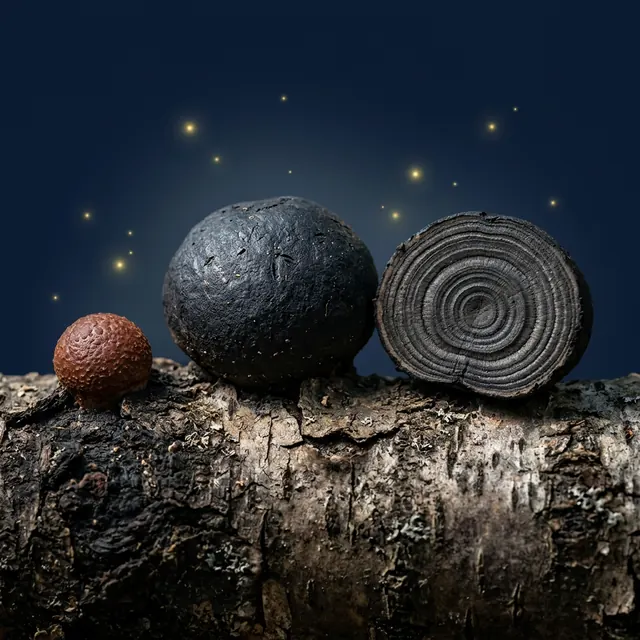
King Alfred's cakes
Daldinia concentrica
How to recognise
- Stromata spherical or tuberous, 3–6 cm, usually in groups.
- Young ones reddish-brown, then black, as if charred; surface smooth, sometimes wrinkled.
- In cross-section fibrous-brittle, brown-black, distinctly layered concentrically (one layer per season).
- The spores, discharged mainly at night, stain the wood around them black.
Up close
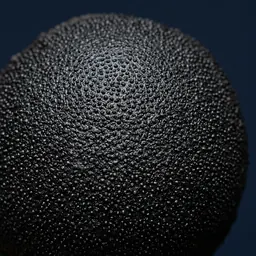 black, smooth
Surface
Black, matt or slightly shiny surface with small, pimple-like openings.
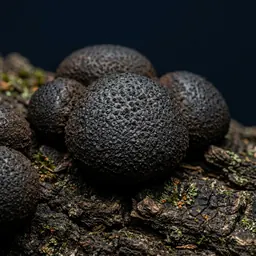 kulka
Shape
Spherical or bulbous stroma 3–6 cm, without a stem, hard as coal.
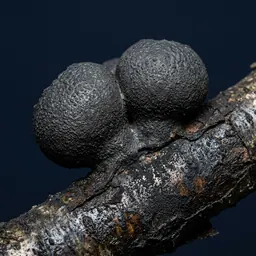 on dead wood
Attachment to wood
Attached by a broad base to a dead trunk or branch, often several next to each other.
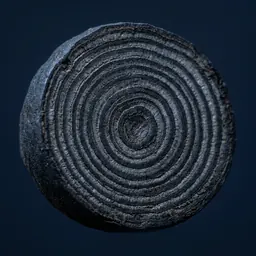 growth rings
Cross-section
Interior brownish-black with distinct concentric layers like a sliced onion.
The close-ups are AI illustrations. Any doubt is settled by a mycologist or herbalist, not by a photo.
Where and when it grows
Dead wood of deciduous trees, mainly fresh, rarely rotting. Perennial stromata visible all year; frequent in Poland, scattered regionally.
JanFebMarAprMayJunJulAugSepOctNovDec
Most often under: dead wood of deciduous trees (e.g. birch).
Beware of the lookalike
Drewniak szkarłatny. Drewniak szkarłatny has smaller, brown to brown-black cushions, without layers in section.
Good to know
Inedible, as hard as charcoal.
Frequently asked questions
Is king alfred's cakes edible?
No, king alfred's cakes is inedible. Inedible, as hard as charcoal.
When does king alfred's cakes grow?
January – December. Dead wood of deciduous trees, mainly fresh, rarely rotting. Perennial stromata visible all year; frequent in Poland, scattered regionally.
King Alfred's cakes: what is it easily confused with?
Most often with the species Drewniak szkarłatny. Drewniak szkarłatny has smaller, brown to brown-black cushions, without layers in section.