

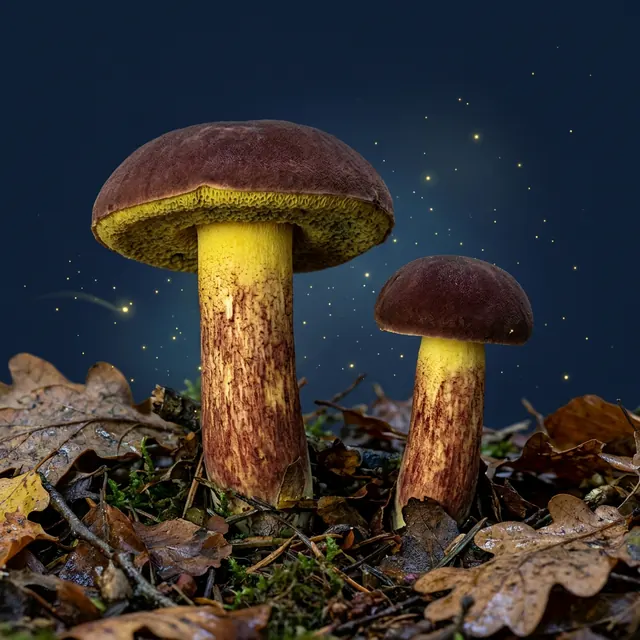
Matt bolete
Xerocomellus pruinatus
Polish folk names: borowik oprószony, podgrzybek oprószony, podgrzybek aksamitny, grzyb oprószony
How to recognise
- Cap 3–10 cm, velvety, dry, uniformly reddish-brown or dark brown; does not crack into small fields even in drought.
- Tubes pale ochre, then pale yellow, turning blue when damaged; pores yellow to yellow-green.
- Stem 5–10 cm tall and 1–2 cm thick, yellow with reddish-brown tints, always yellow just under the cap.
- Flesh yellow, turning slightly blue when damaged, pleasant smell.
Up close
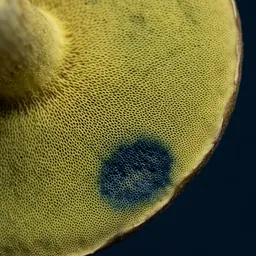 yellow pores
Underside of the cap
Pores whitish at first, then yellow or yellow-green; damaged tubes turn blue.
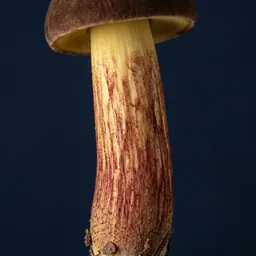 yellow top
Stem
Stem yellow with reddish-brown patches, always pure yellow only right under the cap.
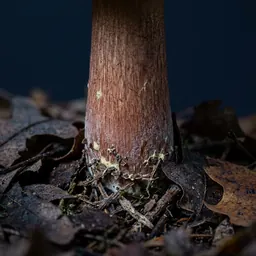 walcowata
Base of the stem
Stem cylindrical, solid and hard, lengthwise fibrous.
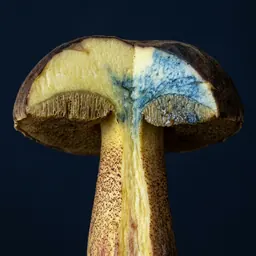 lekko sinieje
Cross-section
Flesh yellow, juicy, turns slightly blue when cut.
The close-ups are AI illustrations. Any doubt is settled by a mycologist or herbalist, not by a photo.
Where and when it grows
Various coniferous and deciduous forests. From September to November, most abundant after the weather turns cooler.
JanFebMarAprMayJunJulAugSepOctNovDec
Most often under: coniferous and deciduous forests.
Beware of the lookalike
Suede bolete. The suede bolete has an olive-brown cap that cracks into patches and a pale stem without red. Both are edible.
In the kitchen
Edible, but often wormy and quickly goes moldy. Collect young, healthy fruiting bodies and fry or stew for about 20 minutes.
Frequently asked questions
Is matt bolete edible?
Yes, matt bolete is an edible mushroom.
When does matt bolete grow?
September – November. Various coniferous and deciduous forests. From September to November, most abundant after the weather turns cooler.
Matt bolete: what is it easily confused with?
Most often with the species Suede bolete. The suede bolete has an olive-brown cap that cracks into patches and a pale stem without red. Both are edible.