

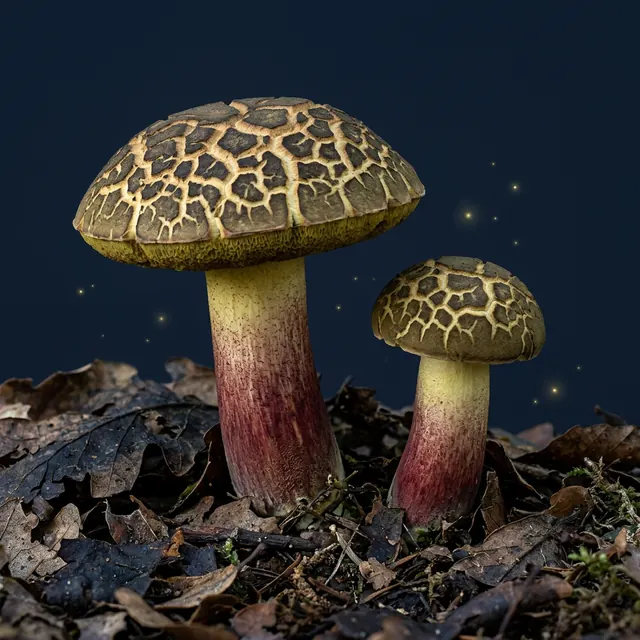
Xerocomellus porosporus
Xerocomellus porosporus
Polish folk names: podgrzybek obciętozarodnikowy, borowik obciętozarodnikowy
How to recognise
- Cap 3–7 cm, hazel-brown to olive-brown, cracking into small fields with pale ochre fissures when mature.
- Stem 3–5 cm tall and up to 1.5 cm thick, pale yellow at the top, wine-red at the bottom, with white mycelium at the base.
- Flesh pale yellow, wine-red only at the base of the stem.
- Spores with truncated ends, 13–15 × 4–5 µm.
Up close
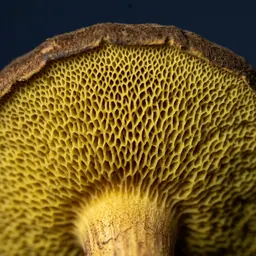 yellow pores
Underside of the cap
Pores yellow to olive-yellow, turning slightly blue when pressed.
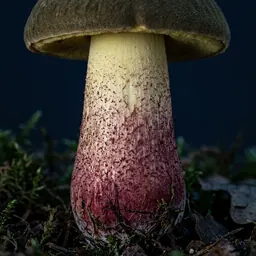 wine-red base
Stem
Stem pale yellow at the top, wine-red in the lower part.
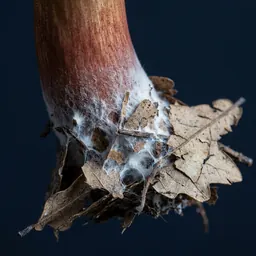 white mycelium
Base of the stem
Base of the stem narrowed, usually covered with white mycelium.
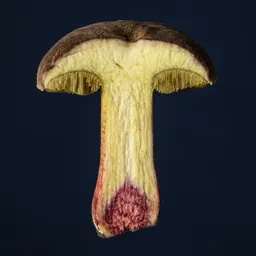 pale yellow
Cross-section
Flesh pale yellow, wine-red only at the base of the stem.
The close-ups are AI illustrations. Any doubt is settled by a mycologist or herbalist, not by a photo.
Where and when it grows
Deciduous and mixed forests, especially under oaks, hornbeams and pines. In autumn; in Poland often not told apart from suchogrzybek złotopory.
JanFebMarAprMayJunJulAugSepOctNovDec
Most often under: oak, hornbeam, beech, pine.
Beware of the lookalike
Red-cracking bolete. Złotopory has reddish fissures in the cap and a carmine stem. Only a microscope reliably tells them apart; both are edible.
In the kitchen
Edible, of medium quality, softens quickly. Best are young fruiting bodies as an addition to a sauce or soup, fried for about 15–20 minutes.
Frequently asked questions
Is xerocomellus porosporus edible?
Yes, xerocomellus porosporus is an edible mushroom.
When does xerocomellus porosporus grow?
August – October. Deciduous and mixed forests, especially under oaks, hornbeams and pines. In autumn; in Poland often not told apart from suchogrzybek złotopory.
Xerocomellus porosporus: what is it easily confused with?
Most often with the species Red-cracking bolete. Złotopory has reddish fissures in the cap and a carmine stem. Only a microscope reliably tells them apart; both are edible.