

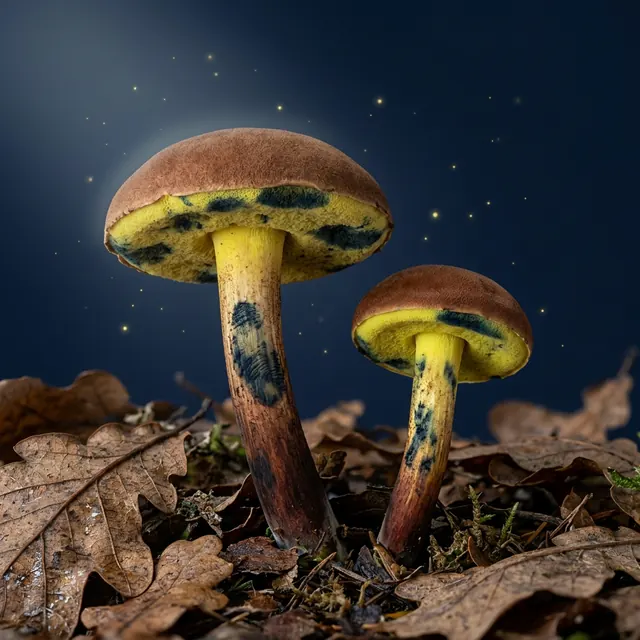
Inkstain bolete
Cyanoboletus pulverulentus
Polish folk names: borowik klinowotrzonowy, borowik czerniejący, borowik omglony, podgrzybek omglony
How to recognise
- Cap 4–12 (15) cm, red-brown or chestnut-brown, matt, delicately velvety.
- Tubes lemon-yellow, short, immediately dark blue when pressed.
- Stem slender, yellowish at the top, hazel to red-brown lower down, narrowed towards the base, never reticulate.
- Flesh yellow, immediately dark blue to blue-black when cut.
Up close
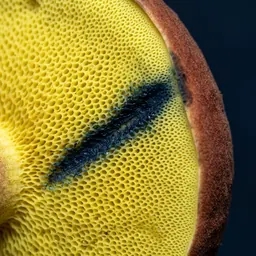 natychmiast sinieje
Underside of the cap
Lemon-yellow tubes turn dark blue immediately when touched.
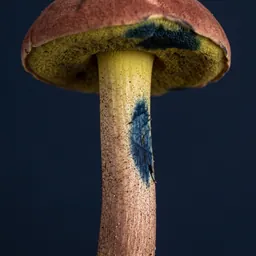 yellow and red
Stem
Stem yellow at the top, reddish-brown lower down, without a net; strongly turns blue when rubbed.
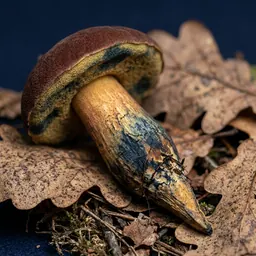 klinowata
Base of the stem
Stem clearly narrowed towards the base, wedge-shaped.
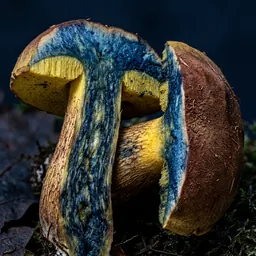 granatowo-czarny
Cross-section
Yellow flesh turns dark blue to almost black immediately when cut.
The close-ups are AI illustrations. Any doubt is settled by a mycologist or herbalist, not by a photo.
Where and when it grows
Deciduous forests under oaks and beeches, less often under pines. From July to October; rare in Poland (status R).
JanFebMarAprMayJunJulAugSepOctNovDec
Most often under: oak, beech, less often pine.
Beware of the lookalike
Bay bolete. The bay bolete has a brown stem, without a yellow top and red bottom, and its pores turn blue less strongly. Sinoborowik turns black immediately and strongly.
Good to know
Formerly considered edible. A 2017 study showed that it accumulates a great deal of arsenic (up to 1300 mg/kg dry weight, mainly in the tubes), so eating it is not recommended.
Frequently asked questions
Is inkstain bolete edible?
No, inkstain bolete is inedible. Formerly considered edible. A 2017 study showed that it accumulates a great deal of arsenic (up to 1300 mg/kg dry weight, mainly in the tubes), so eating it is not recommended.
When does inkstain bolete grow?
July – October. Deciduous forests under oaks and beeches, less often under pines. From July to October; rare in Poland (status R).
Inkstain bolete: what is it easily confused with?
Most often with the species Bay bolete. The bay bolete has a brown stem, without a yellow top and red bottom, and its pores turn blue less strongly. Sinoborowik turns black immediately and strongly.