

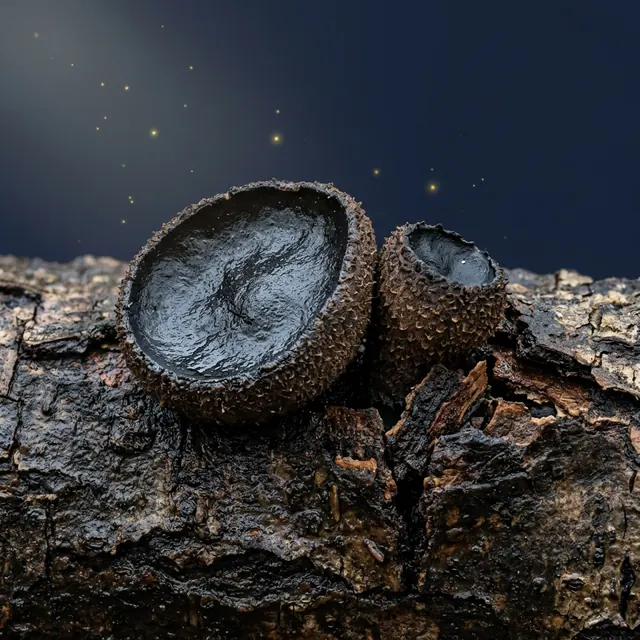
Black bulgar
Bulgaria inquinans
How to recognise
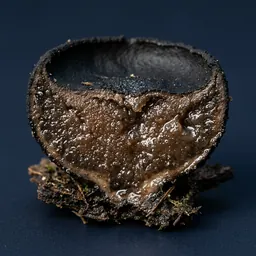
- Young fruiting body conical, dark brown and bran-like-fuzzy; then cup-shaped to disc-shaped, 0.5–4 cm across.
- Upper spore-bearing layer black, moist and shiny.
- Flesh brownish, gelatinous-watery, hard and leathery when dry.
- If you rub the spore-bearing layer with a finger, the finger turns black from the spores.
Up close
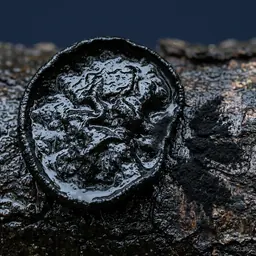 black, stains
Upper side
A black, shiny spore-bearing layer; rubbed with a finger it leaves a black mark.
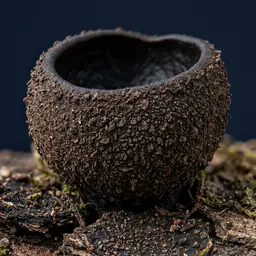 brown, bran-like
Underside
Outside dark brown, rough, bran-like and fibrillose.
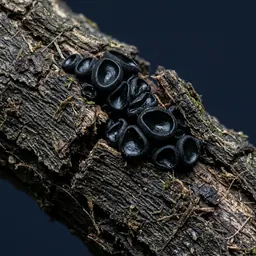 z kory
Attachment to wood
Grows in clusters from the bark crevices of dead branches and logs of oak.
 galareta
Cross-section
Flesh brownish, gelatinous-watery, rubbery; leathery when dry.
The close-ups are AI illustrations. Any doubt is settled by a mycologist or herbalist, not by a photo.
Where and when it grows
Bark of dead branches and logs of oaks, less often hornbeams and elms, usually in groups; also on stored timber. From October to March; fairly common in Poland.
JanFebMarAprMayJunJulAugSepOctNovDec
Most often under: oak, less often hornbeam and elm (bark of dead branches and logs).
Beware of the lookalike
Jelly fungi. Jelly fungi (e.g. kisielnica czarniawa and trzoneczkowa) are also black and gelatinous, but they do not stain the finger. The black bulgar has a brown, scurfy underside.
Good to know
Niejadalny.
Frequently asked questions
Is black bulgar edible?
No, black bulgar is inedible. Niejadalny.
When does black bulgar grow?
January, February, March, October, November, December. Bark of dead branches and logs of oaks, less often hornbeams and elms, usually in groups; also on stored timber. From October to March; fairly common in Poland.
Black bulgar: what is it easily confused with?
Most often with the species Jelly fungi. Jelly fungi (e.g. kisielnica czarniawa and trzoneczkowa) are also black and gelatinous, but they do not stain the finger. The black bulgar has a brown, scurfy underside.