

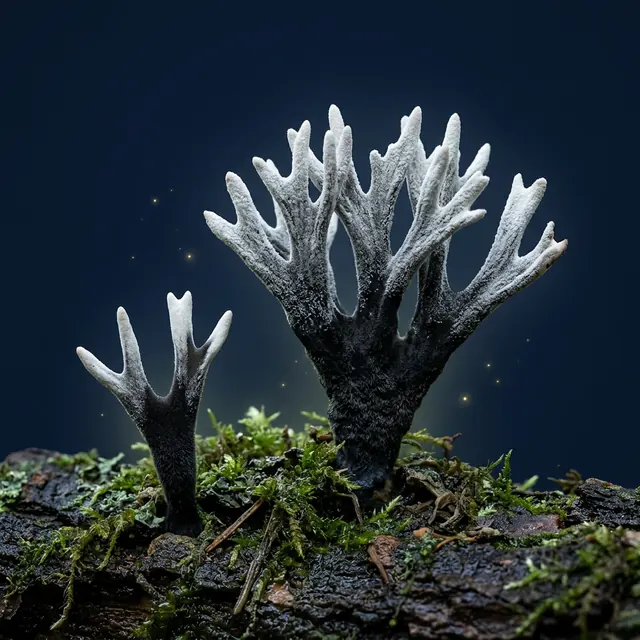
Candlesnuff fungus
Xylaria hypoxylon
How to recognise
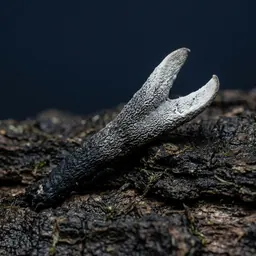
- Stroma flat, spatula-shaped, usually forked like antlers, up to 2 cm, in good conditions up to 8 cm tall.
- Branches 3–5 mm wide, black at the bottom, whitish-grey at the top from powdery conidial spores.
- Very hard and flexible, does not break when bent.
- After the spores are shed it loses its white tips and becomes completely black.
Up close
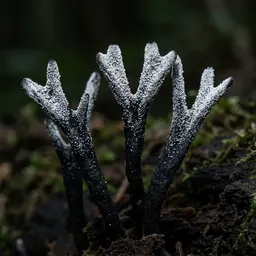 white powder
Tips of the branches
Flattened branch tips covered with white or grey spore dust, like a dusted candle wick.
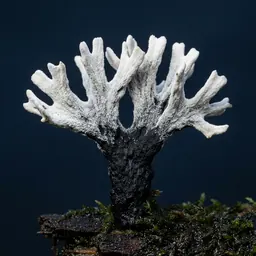 antlers
Shape
Flat, hard branches forked like deer antlers, 2–8 cm.
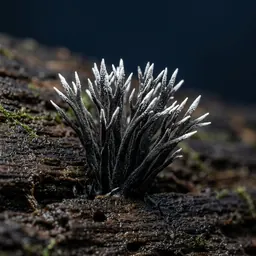 czarna
Base
The lower part is black, velvety, growing in clusters from a stump.
 does not break
Elasticity
The stroma is very hard but elastic: when bent it flexes and does not break.
The close-ups are AI illustrations. Any doubt is settled by a mycologist or herbalist, not by a photo.
Where and when it grows
Stumps and dead wood of deciduous trees, rarely coniferous. All year round; common in Poland.
JanFebMarAprMayJunJulAugSepOctNovDec
Most often under: stumps and dead wood of deciduous trees.
Beware of the lookalike
Beechmast candlesnuff. Próchnilec owocolubny grows from rotting beech fruits (beechmast), not from stumps.
Frequently asked questions
Is candlesnuff fungus edible?
No, candlesnuff fungus is inedible.
When does candlesnuff fungus grow?
January – December. Stumps and dead wood of deciduous trees, rarely coniferous. All year round; common in Poland.
Candlesnuff fungus: what is it easily confused with?
Most often with the species Beechmast candlesnuff. Próchnilec owocolubny grows from rotting beech fruits (beechmast), not from stumps.