

Snowbank false morel
Gyromitra gigas (syn. Discina gigas)
How to recognise
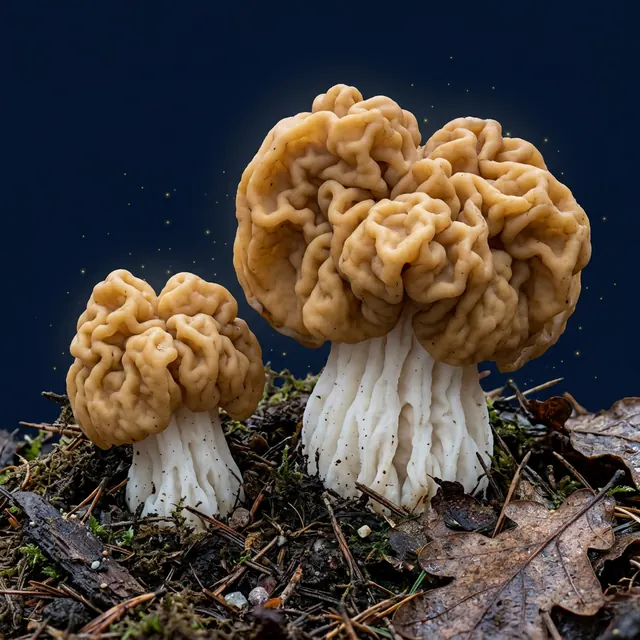
- Head 5–15 cm, irregularly, wavily or brain-like folded, light olive-yellow to ochre-yellow, darkening with age.
- Stem white or pale ochre, thick, short, wavily furrowed, chambered inside.
- The stem is 1/5 to 1/4 of the height of the head and often the same width.
- Flesh white, waxy, very brittle, odourless.
Up close
 brain-like
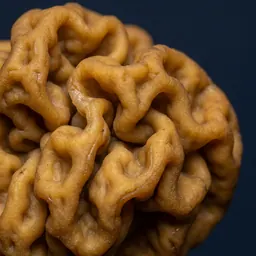
Flower head
Head ochre-yellow, folded like a brain, lobes attached to the stem.
 thick, white
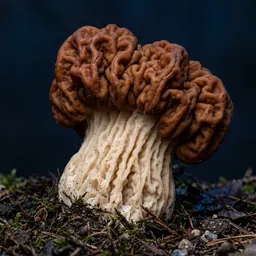
Stem
Stem white, thick and short, as wide as the head, wavy-grooved.
 przy drewnie
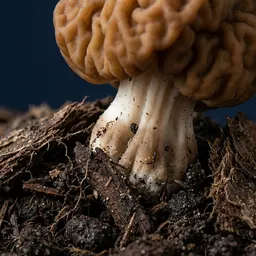
Attachment
Grows from the ground above buried, rotting wood or bark.
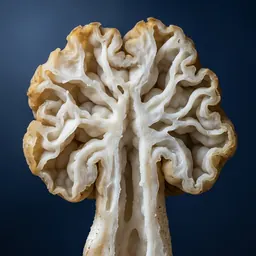 chambers inside
Cross-section
Interior hollow, divided into whitish chambers; flesh waxy and very brittle. Poisonous mushroom.
The close-ups are AI illustrations. Any doubt is settled by a mycologist or herbalist, not by a photo.
Where and when it grows
Damp deciduous forests, especially birch and hornbeam, also spruce; on rotting, buried wood and bark. From March to May.
JanFebMarAprMayJunJulAugSepOctNovDec
Most often under: deciduous forests (birch, hornbeam), also spruce; on buried wood.
Beware of the lookalike
False morel. Kasztanowata is usually smaller and darker, but the two species can only be reliably told apart under a microscope. Do not eat any false morel.
Good to know
On the Red List of Fungi of Poland it has the status V. In France its sale has been banned since 1991.
Frequently asked questions
Is snowbank false morel edible?
Nie. This mushroom is poisonous. Contains trace amounts of gyromitrin, about 1 mg per kg of fresh mushrooms, i.e. many times less than the false morel (piestrzenica kasztanowata). No deaths have been described, but the toxin content can vary, and confusion with the very poisonous false morel is easy.
When does snowbank false morel grow?
March – May. Damp deciduous forests, especially birch and hornbeam, also spruce; on rotting, buried wood and bark. From March to May.
Snowbank false morel: what is it easily confused with?
Most often with the species False morel. Kasztanowata is usually smaller and darker, but the two species can only be reliably told apart under a microscope. Do not eat any false morel.