

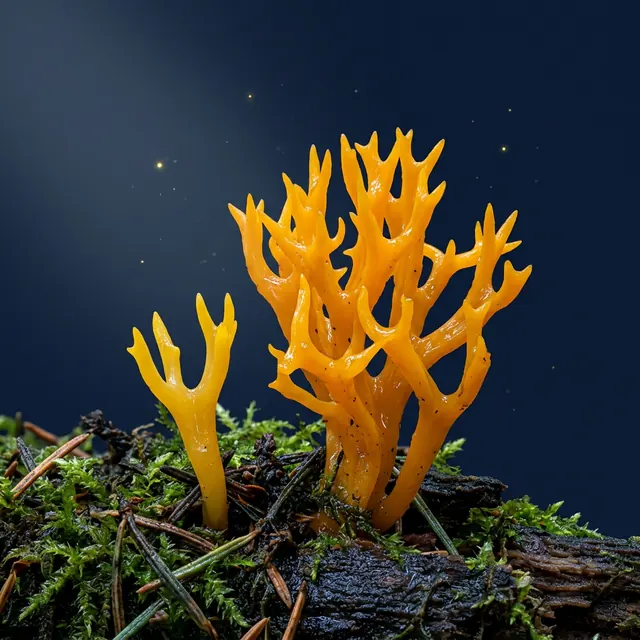
Calocera viscosa
Calocera viscosa
Polish folk names: płaskosz lepki, goździeniec lepki, pięknoróg lepki
How to recognise
- Fruiting body bushy, forked like antlers, up to 8 cm (usually up to 6 cm), branches with 1–3 pointed tips.
- Colour golden, yellow to yellow-orange; darkens and reddens when dry.
- In damp weather the surface is sticky.
- Flesh tough, gelatinous, woody in older ones; stem whitish or whitish-yellow, paler.
Up close
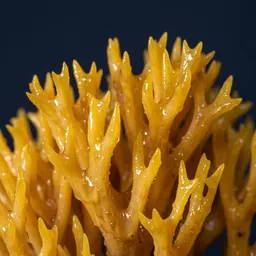 sharp forks
Tips of the branches
Branches ending in 1–3 sharp points, golden-yellow and sticky.
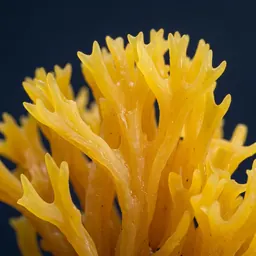 antlers
Shape
A little bush of several forked, rubbery branches up to 8 cm.
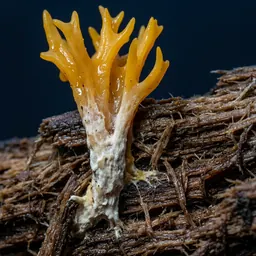 grown into the wood
Base
A whitish, paler stem deeply embedded in dead coniferous wood.
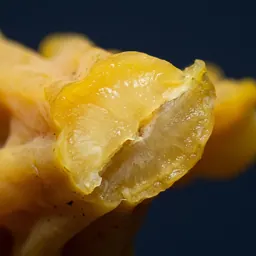 galareta
Cross-section
Flesh hard and gelatinous, rubbery; hollow inside in older ones.
The close-ups are AI illustrations. Any doubt is settled by a mycologist or herbalist, not by a photo.
Where and when it grows
Dead, rotting wood of coniferous trees, mainly stumps, in coniferous and mixed forests. From June to November; very common in Poland.
JanFebMarAprMayJunJulAugSepOctNovDec
Most often under: dead wood and stumps of conifers.
Beware of the lookalike
Lemon coral fungus. Coral fungi grow on the ground, have brittle flesh and a thick, white trunk. Pięknoróg grows from coniferous wood and is rubbery-gelatinous.
Feature-by-feature comparison: Calocera viscosa or Lemon coral fungus?
Good to know
Inedible. Unlike coral fungi, it swells again after drying and wetting.
Frequently asked questions
Is calocera viscosa edible?
No, calocera viscosa is inedible. Inedible. Unlike coral fungi, it swells again after drying and wetting.
When does calocera viscosa grow?
June – November. Dead, rotting wood of coniferous trees, mainly stumps, in coniferous and mixed forests. From June to November; very common in Poland.
Calocera viscosa: what is it easily confused with?
Most often with the species Lemon coral fungus. Coral fungi grow on the ground, have brittle flesh and a thick, white trunk. Pięknoróg grows from coniferous wood and is rubbery-gelatinous.