

Rheubarbariboletus armeniacus
Rheubarbariboletus armeniacus
Polish folk names: podgrzybek brzoskwiniowy
How to recognise
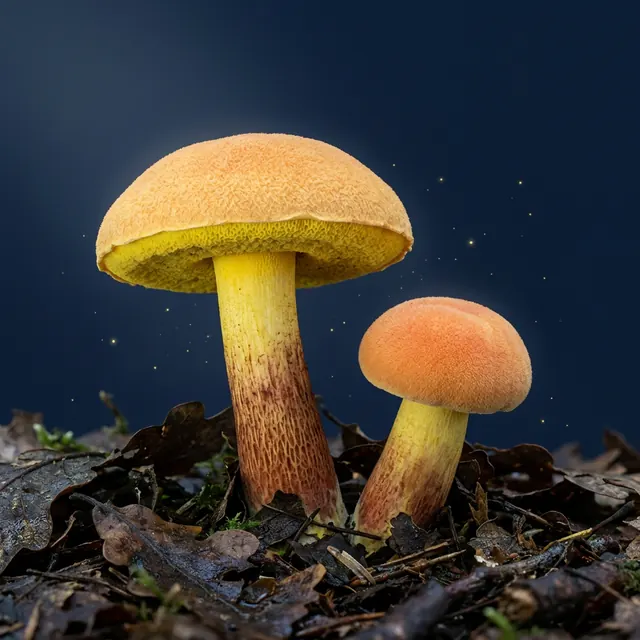
- Cap 3–8 cm, delicately velvety, yellowish with a pink tinge, then apricot-orange or apricot-yellow.
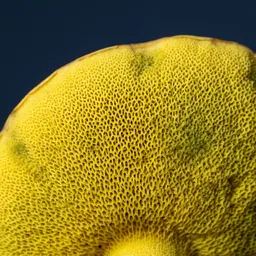
- Tubes 6–12 mm, light yellow, then greenish-yellow; pores of the same colour.
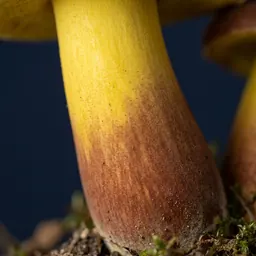
- Stem cylindrical, often bent, yellowish at the top, brownish-red below.
- Flesh light yellow, yellow-orange in the stem; turns blue when damaged, especially above the tubes.
Up close
 yellow pores
Underside of the cap
Tubes and pores pale yellow, greenish-yellow with age.
 yellow-red
Stem
Stem yellowish at the top, brownish-red in the lower part, smooth or slightly suede-like.
 narrowed
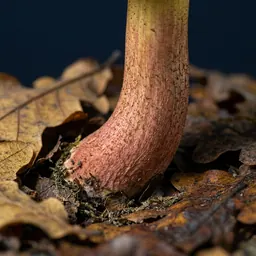
Base of the stem
Stem narrowed at the base, often bent. No ring and no volva.
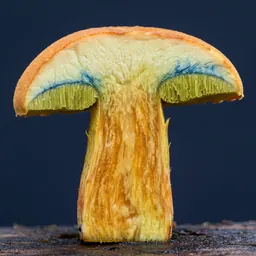 turns blue
Cross-section
Flesh pale yellow, turns sky-blue when cut, most strongly above the tubes.
The close-ups are AI illustrations. Any doubt is settled by a mycologist or herbalist, not by a photo.
Where and when it grows
Shady, warm deciduous forests, mainly under oaks. From June to October. Only 2 sites known in Poland (Janów Lubelski, Kuźnica Białostocka); status E – endangered.
JanFebMarAprMayJunJulAugSepOctNovDec
Most often under: oak (warm deciduous forests).
Beware of the lookalike
Red-cracking bolete. Suchogrzybek złotopory has an olive-brown cap that cracks into patches with red fissures, not an apricot one.
In the kitchen
A species dying out in Poland – do not collect it, even if it is edible. Report the find to mycologists and leave the mushroom in the forest.
Good to know
One of the rarest boletes in Poland. Even if it is listed as edible in some sources, do not collect it.
Frequently asked questions
Is rheubarbariboletus armeniacus edible?
Yes, rheubarbariboletus armeniacus is an edible mushroom.
When does rheubarbariboletus armeniacus grow?
June – October. Shady, warm deciduous forests, mainly under oaks. From June to October. Only 2 sites known in Poland (Janów Lubelski, Kuźnica Białostocka); status E – endangered.
Rheubarbariboletus armeniacus: what is it easily confused with?
Most often with the species Red-cracking bolete. Suchogrzybek złotopory has an olive-brown cap that cracks into patches with red fissures, not an apricot one.