

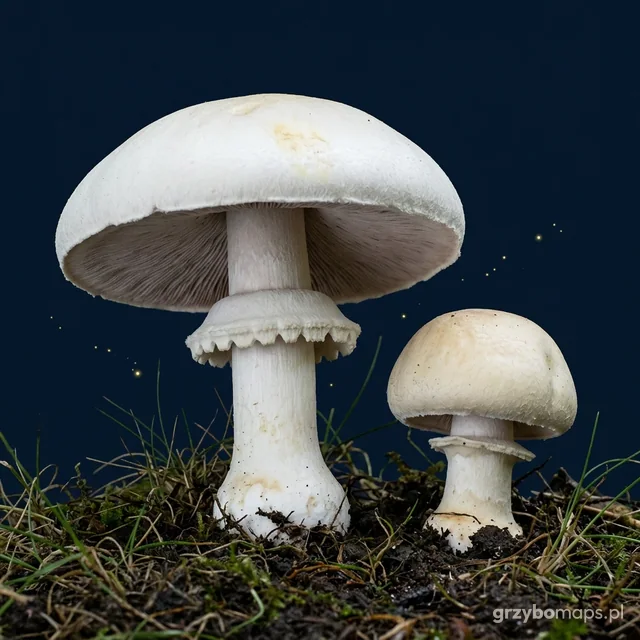
Horse mushroom
Agaricus arvensis
Polish folk names: pieczarka polna, pieczarka owcza, pieczarka polowa
How to recognise
- Cap 7–15 cm, white to cream, smooth, turning yellow when pressed.
- Gills free, first greyish-white, then grey-pink, finally chocolate-brown – never pure white for long.
- Stem white with a large, double ring (with a "cogwheel" on the underside), base without a volva.
- A distinct smell of aniseed or bitter almonds.
Up close
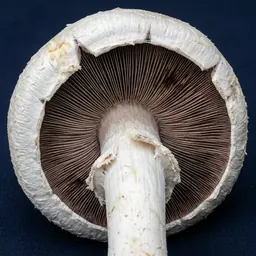 greyish-pink gills
Underside of the cap
Gills free, greyish-white, then greyish-pink and chocolate-brown – never white for long.
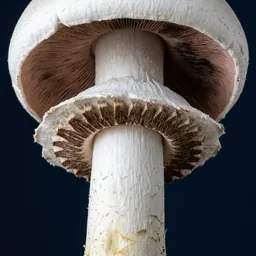 cogwheel
Stem
Large, double ring, with a “cogwheel” on the underside.
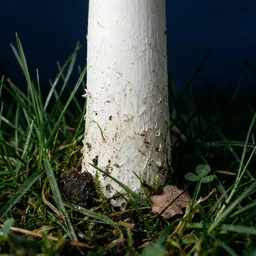 bez pochwy
Base of the stem
Base without a volva; does not turn chrome yellow when cut.
 aniseed
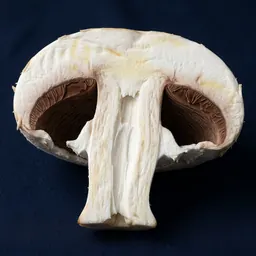
Cross-section
Flesh white, slowly turning slightly yellowish; distinct smell of aniseed.
The close-ups are AI illustrations. Any doubt is settled by a mycologist or herbalist, not by a photo.
Where and when it grows
Meadows, pastures, fertilised lawns, sometimes forest edges; from June to October.
JanFebMarAprMayJunJulAugSepOctNovDec
Most often under: none – meadows and pastures; sometimes forest edges.
Beware of the lookalike
Destroying angel. An amanita has white gills and a bulb in a sheath at the base all its life. A field mushroom has no sheath, and its gills quickly turn grey and brown. You tell it from the poisonous yellow stainer by its aniseed smell instead of an ink/phenol smell.
Feature-by-feature comparison: Horse mushroom or Yellow stainer?
In the kitchen
Tasty fried, stewed and in soups, like the cultivated button mushroom.
Good to know
Before picking, smell the cut base of the stem: an aniseed smell – pieczarka biaława; an ink/phenol smell and strong yellowing of the base – the poisonous yellow stainer. Yellowing mushrooms accumulate cadmium, so do not eat them often and do not pick them by roads.
Where in Poland
Most records in the GBIF database: wielkopolskie, dolnośląskie, lubuskie, śląskie, zachodniopomorskie.
Recipes with this mushroom
Frequently asked questions
Is horse mushroom edible?
Yes, horse mushroom is an edible mushroom.
When does horse mushroom grow?
June – October. Meadows, pastures, fertilised lawns, sometimes forest edges; from June to October.
Horse mushroom: what is it easily confused with?
Most often with the species Destroying angel. An amanita has white gills and a bulb in a sheath at the base all its life. A field mushroom has no sheath, and its gills quickly turn grey and brown. You tell it from the poisonous yellow stainer by its aniseed smell instead of an ink/phenol smell.
Where in Poland does horse mushroom grow?
Most records (GBIF): wielkopolskie, dolnośląskie, lubuskie, śląskie, zachodniopomorskie. Most often under: none – meadows and pastures; sometimes forest edges.