

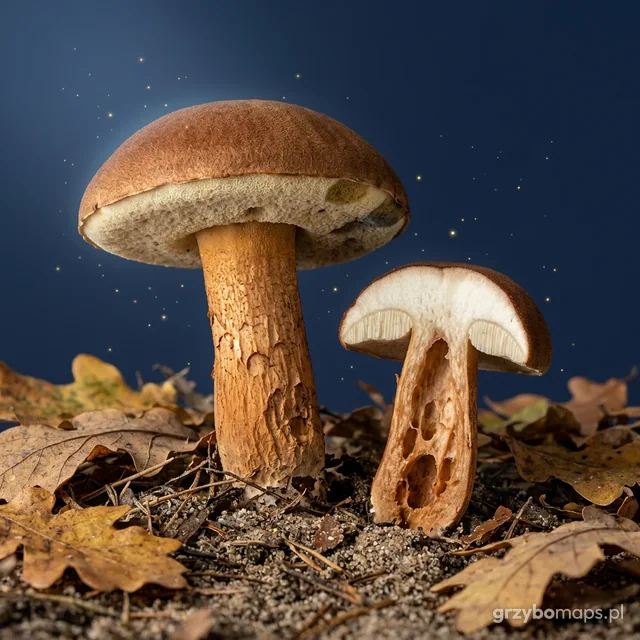
Chestnut bolete
Gyroporus castaneus
How to recognise
- Cap rusty to chestnut-brown, suede-like.
- Tubes short, white, then yellowish.
- Stem the colour of the cap, brittle, chambered and hollow inside.
- Flesh white, does not change colour when cut.
Up close
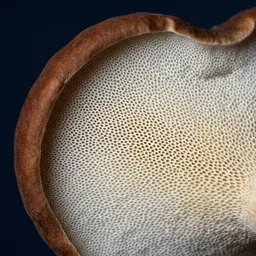 white tubes
Underside of the cap
Tubes short, white, then yellowish; they do not turn blue.
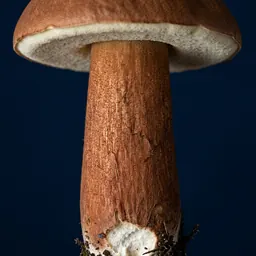 kruchy
Stem
Stem the colour of the cap, smooth, brittle.
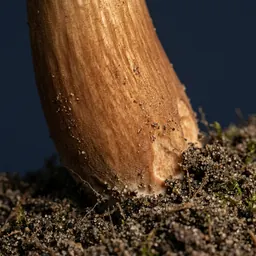 bez pochwy
Base of the stem
Base without a volva; grows on sandy soil.
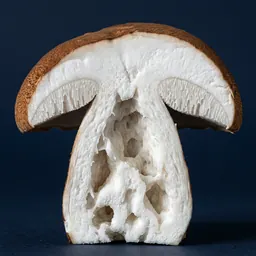 chambers in the stem
Cross-section
Flesh white, does not change colour; stem with chambers inside, hollow.
The close-ups are AI illustrations. Any doubt is settled by a mycologist or herbalist, not by a photo.
Where and when it grows
Warm deciduous and mixed forests, usually on sandy soils, under oaks and beeches. From July to October, not very common.
JanFebMarAprMayJunJulAugSepOctNovDec
Most often under: oak, beech, birch (sandy soils).
Beware of the lookalike
Cornflower bolete. The cornflower bolete has a paler, straw-yellow cap and flesh that turns an intense blue at once; the chestnut bolete does not turn blue.
In the kitchen
For soups and sauces, dries well; parboil thoroughly.
Where in Poland
Most records in the GBIF database: łódzkie, pomorskie, śląskie, wielkopolskie, warmińsko-mazurskie.
Frequently asked questions
Is chestnut bolete edible?
Yes, chestnut bolete is an edible mushroom.
When does chestnut bolete grow?
July – October. Warm deciduous and mixed forests, usually on sandy soils, under oaks and beeches. From July to October, not very common.
Chestnut bolete: what is it easily confused with?
Most often with the species Cornflower bolete. The cornflower bolete has a paler, straw-yellow cap and flesh that turns an intense blue at once; the chestnut bolete does not turn blue.
Where in Poland does chestnut bolete grow?
Most records (GBIF): łódzkie, pomorskie, śląskie, wielkopolskie, warmińsko-mazurskie. Most often under: oak, beech, birch (sandy soils).