

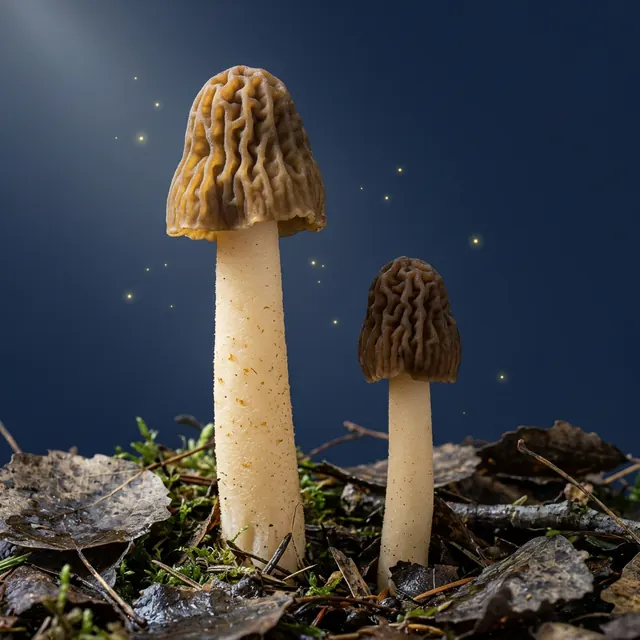
Wrinkled thimble-cap
Verpa bohemica
Partially protected species
Polish folk names: smardzówka czeska
How to recognise
- Fruiting body 10–20 cm tall, with a head and a long stem.
- Head 2–5 cm, conical to bell-shaped, yellow-brown to dark brown, with low, wavy, longitudinal ribs.
- The head is attached only at the top, its margin hangs freely away from the stem.
- Stem 7–20 cm, cream, brittle, at first filled with cottony flesh inside, later hollow.
Up close
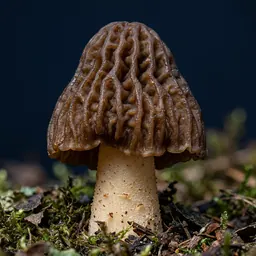 folded thimble
Flower head
Brown, bell-shaped head with low, wavy, lengthwise ribs, without the deep honeycomb chambers.
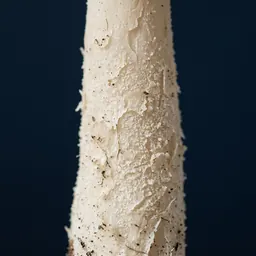 long, pale
Stem
Stem 7–20 cm, cream, with small fibrils or ochre speckles, brittle.
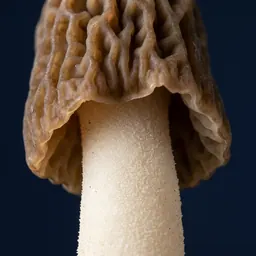 brzeg wolny
Base
The edge of the head hangs free around the stem; the head is attached to the stem only at the very top.
 cottony stem
Cross-section
In section the head is attached only at the top, the stem filled with white, cottony flesh.
The close-ups are AI illustrations. Any doubt is settled by a mycologist or herbalist, not by a photo.
Where and when it grows
Early spring, from March to May, in deciduous forests, floodplain forests, thickets and parks, especially under aspens, ash trees and alders. Rare in Poland (about 120 sites), on the Red List as vulnerable.
JanFebMarAprMayJunJulAugSepOctNovDec
Most often under: aspen, ash, alder (deciduous forests, floodplain forests, parks).
Beware of the lookalike
Common morel. In the morel, the head is fused to the stem along its whole lower margin, and in section forms one hollow chamber with it. In the thimble-cap, the head hangs free, joined only at the top.
Feature-by-feature comparison: Wrinkled thimble-cap or Common morel?
In the kitchen
Gatunek chroniony: nie zbieraj go. Zostaw w lesie; to rzadki grzyb wczesnej wiosny.
Good to know
Polish sources list it as edible. However, poisonings have been described in sensitive people after eating a larger amount or several days in a row: gastrointestinal complaints and disturbed coordination of movement, as well as alcohol intolerance. The toxins have not been confirmed in studies.
Frequently asked questions
Is wrinkled thimble-cap edible?
Warunkowo. Polish sources list it as edible. However, poisonings have been described in sensitive people after eating a larger amount or several days in a row: gastrointestinal complaints and disturbed coordination of movement, as well as alcohol intolerance. The toxins have not been confirmed in studies.
When does wrinkled thimble-cap grow?
March – May. Early spring, from March to May, in deciduous forests, floodplain forests, thickets and parks, especially under aspens, ash trees and alders. Rare in Poland (about 120 sites), on the Red List as vulnerable.
Wrinkled thimble-cap: what is it easily confused with?
Most often with the species Common morel. In the morel, the head is fused to the stem along its whole lower margin, and in section forms one hollow chamber with it. In the thimble-cap, the head hangs free, joined only at the top.