

Jelly ear
Auricularia auricula-judae
Polish folk names: ucho Judasza, grzyb mun, judaszowe ucho
How to recognise
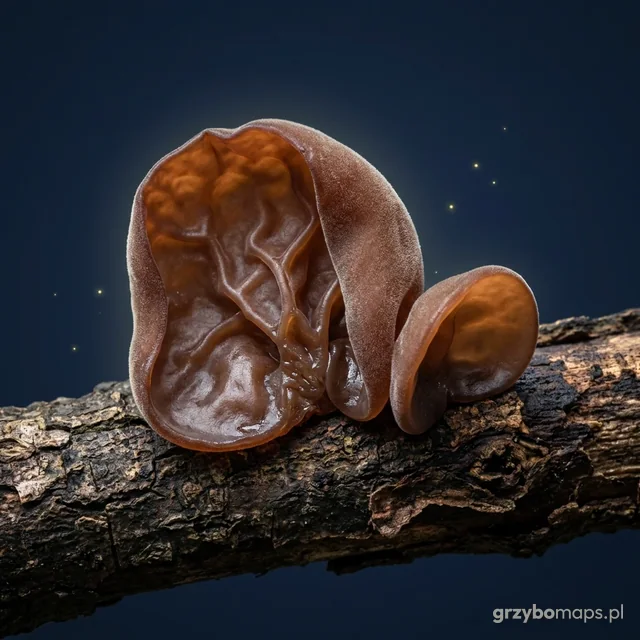
- Fruiting body ear- or shell-shaped, 3–10 cm, thin, gelatinous-rubbery.
- Outer side brown, delicately velvety; inner side smooth, often with folds like veins.
- Grows in clusters on dead and living branches, most often of elder.
- In drought it shrinks and hardens, after rain it swells again.
Up close
 veins
Inner side
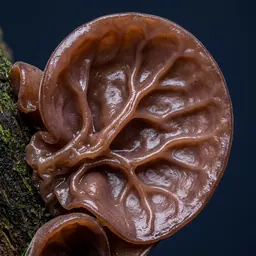
Inner side smooth, often with folds like veins; no gills.
 aksamitna
Outer side
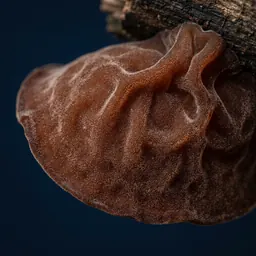
Outer side brown, delicately velvety; no stem.
 on an elder
Attachment
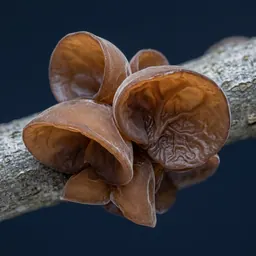
Attaches sideways to dead and living branches, most often of black elder.
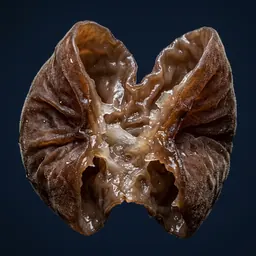 galaretowaty
Cross-section
Flesh thin, gelatinous-rubbery, translucent.
The close-ups are AI illustrations. Any doubt is settled by a mycologist or herbalist, not by a photo.
Where and when it grows
On branches of elder, less often maples, ash trees and willows, in thickets, parks and floodplain forests. All year round, most in spring and autumn in damp weather.
JanFebMarAprMayJunJulAugSepOctNovDec
Most often under: elder, also maple, ash, willow.
Beware of the lookalike
Tripe fungus. The tripe fungus (Auricularia mesenterica) forms flat, hairy, zoned shelves on trunks (mainly elms); it is tough and inedible, but not poisonous.
In the kitchen
Wash thoroughly, cut into strips and boil or fry (e.g. in Asian dishes, soups); soak the dried form before use.
Good to know
Eat only after cooking. Contains substances that reduce blood clotting – be careful if you take anticoagulant medication.
Where in Poland
Most records in the GBIF database: mazowieckie, wielkopolskie, małopolskie, zachodniopomorskie, śląskie.
Recipes with this mushroom
Frequently asked questions
Is jelly ear edible?
Warunkowo. Eat only after cooking. Contains substances that reduce blood clotting – be careful if you take anticoagulant medication.
When does jelly ear grow?
January – December. On branches of elder, less often maples, ash trees and willows, in thickets, parks and floodplain forests. All year round, most in spring and autumn in damp weather.
Jelly ear: what is it easily confused with?
Most often with the species Tripe fungus. The tripe fungus (Auricularia mesenterica) forms flat, hairy, zoned shelves on trunks (mainly elms); it is tough and inedible, but not poisonous.
Where in Poland does jelly ear grow?
Most records (GBIF): mazowieckie, wielkopolskie, małopolskie, zachodniopomorskie, śląskie. Most often under: elder, also maple, ash, willow.