

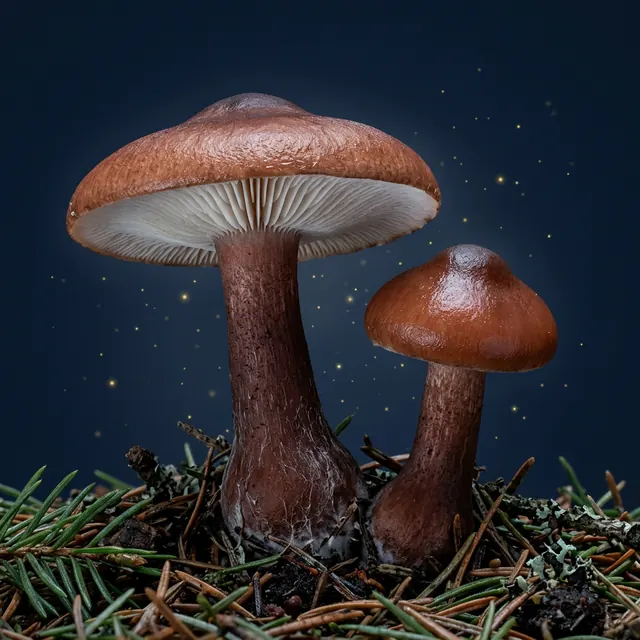
Butter cap
Rhodocollybia butyracea
Polish folk names: pieniążek maślany, bedłka maślana
How to recognise
- Cap 4–7 cm, spreading with an umbo, strongly water-absorbing: rust-brown to red-brown when wet, pale ochre when dry.
- Margin and umbo usually darker; skin smooth, slightly greasy.
- Gills white, almost free.
- Stem light to red-brown, cartilaginous and rubbery, swollen at the base, with white fibrils.
Up close
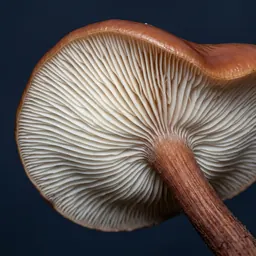 white gills
Underside of the cap
Gills white, crowded, only briefly attached at the top, looking almost free.
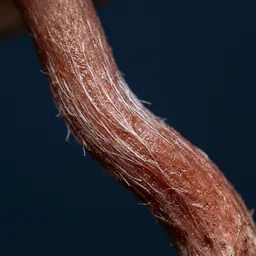 cartilaginous
Stem
Stem reddish-brown, rubbery and springy on the outside, with white fibrils.
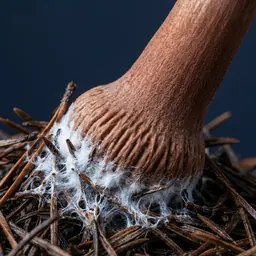 swollen
Base of the stem
Base swollen like a club, grooved lengthwise, with a white bloom of mycelium.
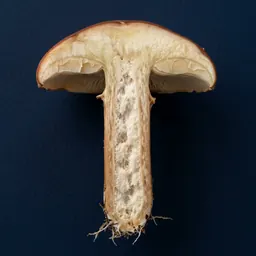 cottony centre
Cross-section
The outer layer of the stem is cartilaginous, the centre cottony-spongy. Flesh watery.
The close-ups are AI illustrations. Any doubt is settled by a mycologist or herbalist, not by a photo.
Where and when it grows
Deciduous and coniferous forests, mostly on acidic soils, in leaf litter. From summer to late autumn; common in Poland.
JanFebMarAprMayJunJulAugSepOctNovDec
Most often under: deciduous and coniferous forests on acidic soils.
Beware of the lookalike
Soap-scented toadstool. The soap-scented toadstool smells of soap, has a fleshy stem without a cartilaginous skin and often greenish shades.
In the kitchen
Eat only the caps, the stems are fibrous. Good as an addition to a sauce or stewed mushrooms, cooked for at least 20 minutes.
Frequently asked questions
Is butter cap edible?
Yes, butter cap is an edible mushroom.
When does butter cap grow?
July – November. Deciduous and coniferous forests, mostly on acidic soils, in leaf litter. From summer to late autumn; common in Poland.
Butter cap: what is it easily confused with?
Most often with the species Soap-scented toadstool. The soap-scented toadstool smells of soap, has a fleshy stem without a cartilaginous skin and often greenish shades.