

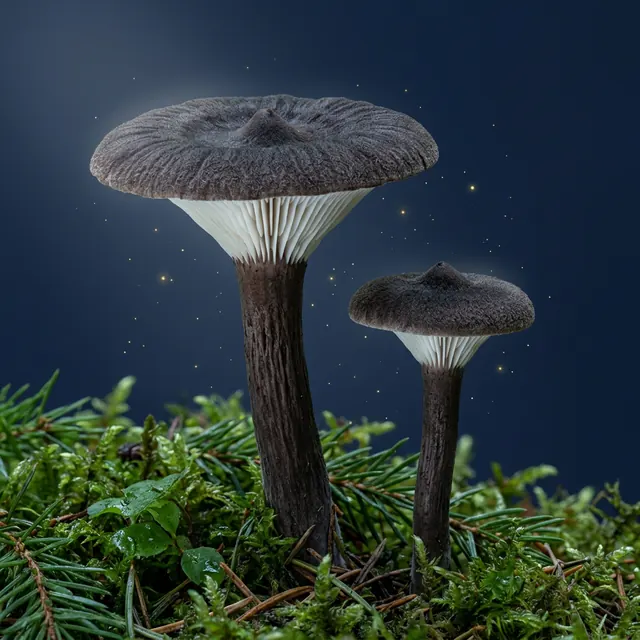
Lactarius lignyotus
Lactarius lignyotus
How to recognise
- Cap 3–11 cm, with a small umbo, dry, felty, dark brown to brownish-black, radially wrinkled in older ones.
- Gills white, running down the stem, where they turn brown.
- Stem 4–10 cm tall and 0.5–1.2 cm thick, sepia-brown, with longitudinal grooves in the upper part.
- Milk white, watery, after a few minutes pale pink to salmon; taste mild with a slightly bitter aftertaste.
Up close
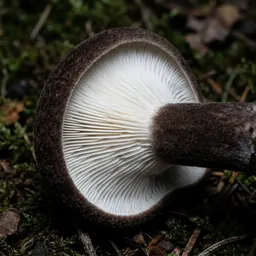 white gills
Underside of the cap
Snow-white gills contrast strongly with the blackish-brown cap.
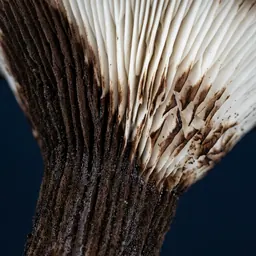 grooves
Stem
Dark stem; in the upper part lengthwise grooves into which the decurrent gills run, turning brown.
 w mchu
Base of the stem
A slender dark stem grows from moss under spruces.
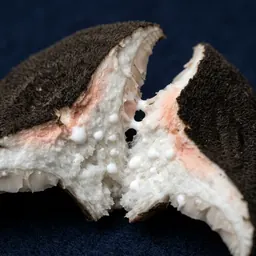 latex turning pink
Cross-section
Flesh white; the white latex turns pink after a few minutes.
The close-ups are AI illustrations. Any doubt is settled by a mycologist or herbalist, not by a photo.
Where and when it grows
Coniferous forests, mainly in the mountains, under spruces, often among mosses. From August to October; rare in Poland.
JanFebMarAprMayJunJulAugSepOctNovDec
Most often under: spruce (mountain forests).
Beware of the lookalike
Mleczaj ciemny. Mleczaj ciemny has gills that do not run down onto the stem and do not change colour there, and its cap is not radially wrinkled.
Frequently asked questions
Is lactarius lignyotus edible?
No, lactarius lignyotus is inedible.
When does lactarius lignyotus grow?
August – October. Coniferous forests, mainly in the mountains, under spruces, often among mosses. From August to October; rare in Poland.
Lactarius lignyotus: what is it easily confused with?
Most often with the species Mleczaj ciemny. Mleczaj ciemny has gills that do not run down onto the stem and do not change colour there, and its cap is not radially wrinkled.