

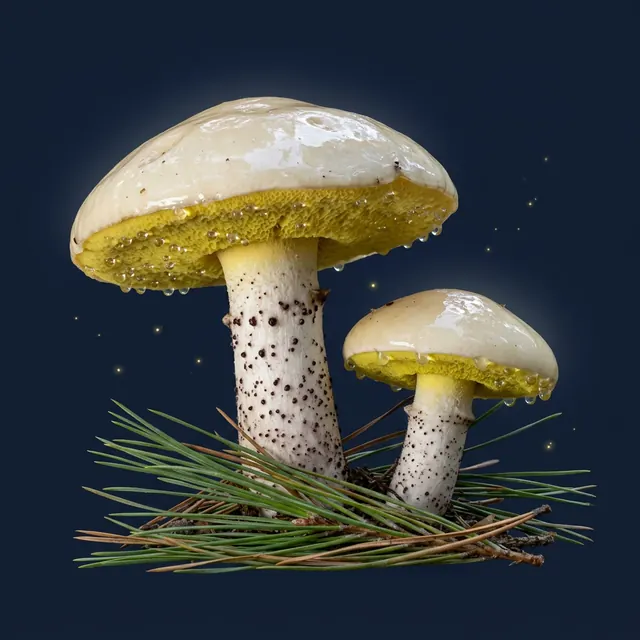
White slippery Jack
Suillus placidus
Polish folk names: maślak łagodny
How to recognise
- Cap 3–13 cm, smooth, slimy and sticky, at first ivory, whitish-yellow or cream, then yellow-brown.
- Tubes 5–11 mm, whitish, then lemon-yellow to yellow-brown; pores small, exuding droplets of juice.
- Stem 3–8 cm, whitish or yellowish, without a ring, with dried granules of juice that darken to violet-brown.
- Flesh soft, white or yellowish, short-lived.
Up close
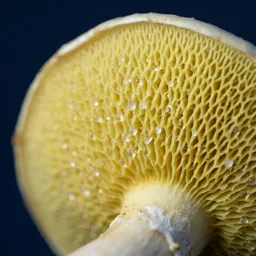 yellow tubes
Underside of the cap
Tubes whitish, then lemon-yellow; the small pores exude milky droplets.
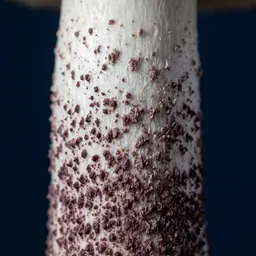 no ring
Stem
Whitish stem without a ring, with granules of dried sap that darken to violet-brown.
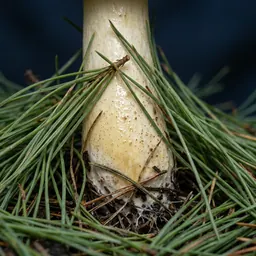 under Weymouth pine
Base of the stem
Stem cylindrical, sometimes spindle-shaped. Grows under the Weymouth pine, with long, soft needles in bundles of 5.
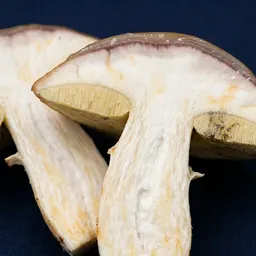 soft flesh
Cross-section
Flesh white or yellowish, soft and juicy; under the skin of the cap it may be purple.
The close-ups are AI illustrations. Any doubt is settled by a mycologist or herbalist, not by a photo.
Where and when it grows
On the ground under Weymouth pine, less often under Swiss stone pine and other five-needle pines, also in parks. From July to October; rare in Poland.
JanFebMarAprMayJunJulAugSepOctNovDec
Most often under: Weymouth pine (less often Swiss stone pine and other five-needle pines).
Beware of the lookalike
Sticky bolete. The sticky bolete has a greyish cap with remnants of the veil, a thin ring and greyish pores; it grows under larches.
In the kitchen
Edible, but of low value. Remove the slimy skin and fry or stew for about 20 minutes, preferably as an addition to other mushrooms.
Frequently asked questions
Is white slippery jack edible?
Yes, white slippery jack is an edible mushroom.
When does white slippery jack grow?
July – October. On the ground under Weymouth pine, less often under Swiss stone pine and other five-needle pines, also in parks. From July to October; rare in Poland.
White slippery Jack: what is it easily confused with?
Most often with the species Sticky bolete. The sticky bolete has a greyish cap with remnants of the veil, a thin ring and greyish pores; it grows under larches.